
Journal title (In Regional) களஞ்சியம் - சர்வதேச தமிழ் ஆய்வு இதழ்
Journal title (In English) KALANJIYAM – International Journal of Tamil Studies
Publication language Tamil (தமிழ்), English, Abstract and References in English
Abbreviated key-title: KALANJIYAM - KIJTS
Publishing frequency Quarterly (February, May, August, and November)
E-ISSN 2456-5148
DOI registered Tamil Journal
Vol. 5 No. 04 (2026): Sangam Literature, The Tirukkural, and The Epic Vision of Tamil Classics: Ethics, Aesthetics, and Global Resonance - Special Issue
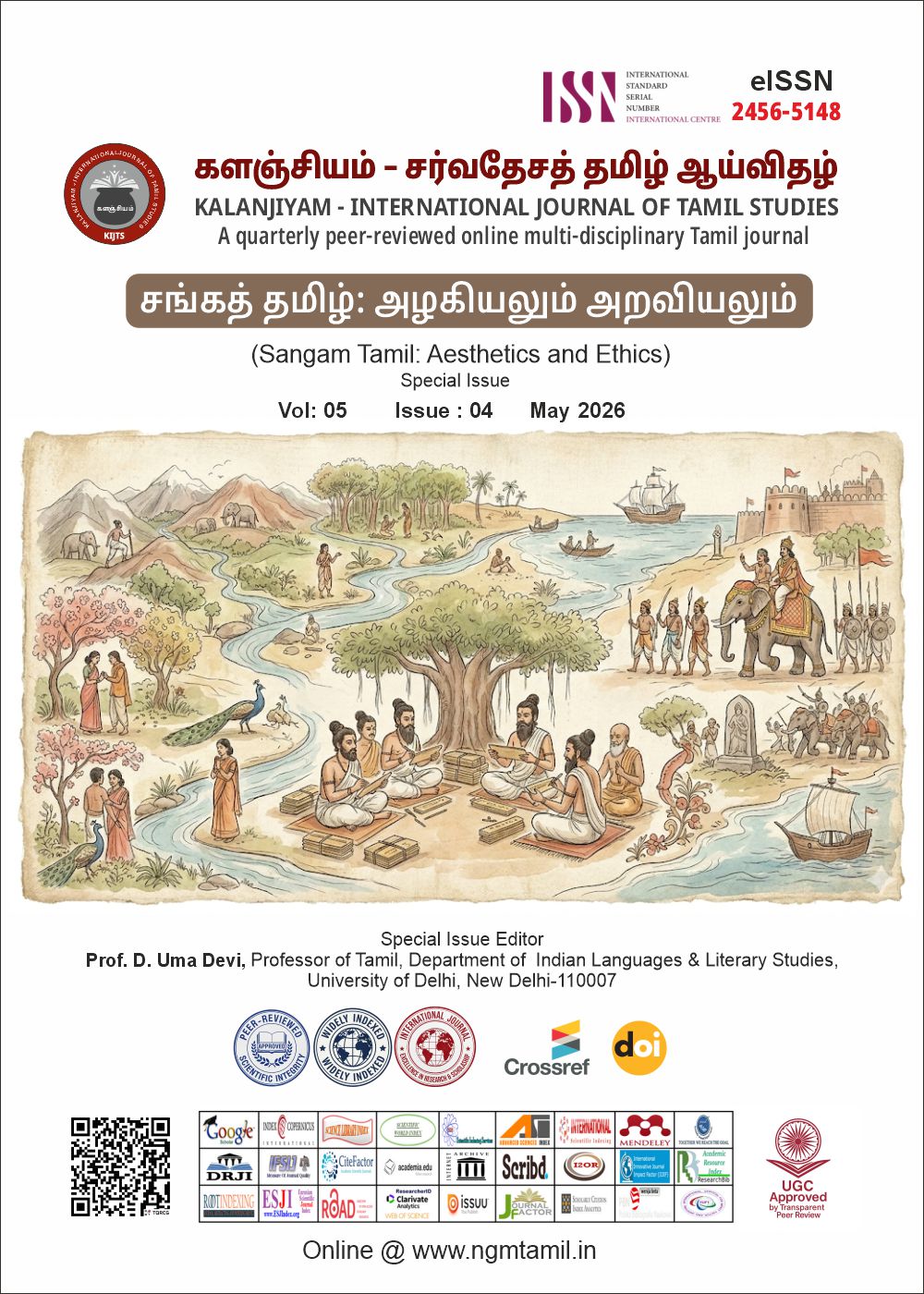
களஞ்சியம் – சர்வதேசத் தமிழ் ஆய்விதழ் தொகுதி (Vol): 05 | இதழ் (Issue): 04 | மாதம்: மே 2026
சங்க இலக்கியம், திருக்குறள் மற்றும் தமிழ் செவ்விலக்கியங்களின் காப்பியப் பார்வை: அறவியல், அழகியல் மற்றும் உலகளாவிய எதிரொலி - சிறப்பு மலர்
The May 2026 special issue of the Kalanjiyam International Tamil Research Journal (Vol. 5, Issue 4), guest-edited by Prof. Dr. T. Umadevi, is themed "Sangam Literature, The Tirukkural, and The Epic Vision of Tamil Classics: Ethics, Aesthetics, and Global Resonance." This edition offers a modern re-reading of ancient Tamil literature by applying contemporary frameworks like eco-criticism, semiotics, and feminism to classical texts. The featured articles deeply explore aesthetic elements—such as classical musical traditions, theatrical symbolism in Silappatikaram, and the female gaze in Sangam poetry—alongside core ethical principles like justice, Buddhist monasticism in Manimekalai, and environmental ethics in Thirukkural, aiming to open new avenues in Tamil literary research.
Articles
-
Pearls and Pearls diving in Sangam Literature: Symbolism, Economy, and Cultural Imagination
Prof. D. Uma Devi Professor of Tamil, Department of Indian Languages & Literary Studies, University of Delhi, New Delhi-110007 IndiaPearls occupy a significant place in Sangam literature, functioning not merely as objects of ornamentation but as complex cultural symbols. This paper examines the multifaceted representation of pearls in major Sangam texts such as Akanānūru, Naṟṟiṇai, Pathitr̥uppattu, and Maduraikanchi. It explores how pearls operate across both akam (interior) and puram (exterior) traditions, symbolizing beauty, emotional states, political authority, economic activity, and ecological imagination. Special attention is given to the practice of pearl diving (muthu kulithal), as depicted in these texts, highlighting the labor, skill, and maritime knowledge of the Parathavar community, as well as the risks and rituals associated with the profession. The study also emphasizes the role of pearls in articulating feminine subjectivity, royal power, and coastal economies. By analyzing literary references and thematic contexts, this paper argues that pearls, together with the cultural practice of pearl diving, serve as a unifying motif that connects the inner emotional world with the outer material, social, and ecological realities of ancient Tamil society.
Pages: 1-9Views: 0 Downloads: 00 0Prof. D. Uma Devi (1)- (1) Professor of Tamil, Department of Indian Languages & Literary Studies, University of Delhi, New Delhi-110007
The Multifaceted Role of the Yazh in the Tamil Musical Tradition of the Sangam Period
Thangarasa Kopinath Ph.D. Scholar in Music, Department of Music, Faculty of Music & Fine Arts, University of Delhi, Delhi. IndiaDuring the Sangam period, assemblies of learned scholars played a crucial role in the development and promotion of the Tamil language and Tamil music. The Literary works of the Sangam corpus provide substantial evidence for the cultural and musical traditions of the era. In particular, the texts belonging to the Ettuthokai & Patthppattu, which are part of the classical Sangam literature, contain numerous references to Tamil music and musical instruments. The Yazh was a stringed instrument that produced music through vibrating strings. The string and wind instruments that existed during the Sangam period were generally categorized. Among these instruments, the Yazh was considered the most significant string instrument. It was played in both Akam & Puram contexts in Sangam socity. Various types of Yazh were used across the landscapes associated with the five ecological regions (Thinai) of ancient Tamil culture. Several varieties of the instrument have been identified in Sangam Literature. Such as: Siriyazh, Periyazh, Senkootu Yazh, Sakota Yazh, Karungottu Yazh & Vil Yazh. These varieties differed mainly in their structural design and number and arrangement of strings. The yazh played an important role in the daily lives of people in the Sangam period. It was used by professional muscians such as Panar & Viraliyar to entertain audiences. Provide emotional comfort, celebrate victories in war, and accompany dance and ceremonial performances. Therefore, the Yazh occupied a significant place in the cultural and social life of the Sangam people.
In the Sangam period, when technological development had not yet advanced significantly, the Yazh nevertheless exhibited remarkable sophistication in its construction, performance technique, and musical application. This study aims to examine the structure, development, performance techniques, and musical significance of the Yazh. It also seeks to revisit and document the available literary evidence concerning the instrument in order to introduce its musical heritage to contemporary generations who may not be familiar with ancient Tamil musical traditions. Although several studies have been conducted on the structure, performance techniques, varieties & cultural significance of the Yazh, systematic research remains limited. Furthermore, the Yazh gradually disappeared from practical musical usage over time, largely due to the emergence and evolution of other musical instruments. As a result, references to the Yazh are mostly preserved in literary sources rather than in living musical practice.
This research focuses on examining the references and descriptions of the Yazh found in Sangam literature. The study relies on both primary and secondary sources. Primary sources include the Sangam literary texts & their commentaries, while secondary sources include scholarly research works, academic articles & journals. This research adopts historical, descriptive & analytical methodologies to study the musical instrument in relation to literary evidence and the cultural practices of ancient Tamil society..
Pages: 10-16Views: 0 Downloads: 00 0Thangarasa Kopinath (1)- (1) Ph.D. Scholar in Music, Department of Music, Faculty of Music & Fine Arts, University of Delhi, Delhi., India
10-16சிலப்பதிகாரத்தின் வணிகப் பரிமாணம் The Commercial Dimension of Silappatikaram
Sathish R Ph.D. Research Scholar, Dept. of Indian Languages and Literary Studies, University of Delhi, Delhi -110007 IndiaThis article examines the unprecedented occurrence of selecting characters with a commercial background as the protagonists in Silappatikaram, the first epic composed in the Tamil literary tradition. The paper highlights how the Jain religion, while using the epic Silappatikaram to give literary form to its philosophy, simultaneously elevates the mercantile community—which heavily supported it socially and held immense influence in contemporary society—to the prestigious position of leading the epic narrative. The commercial dimension of Silappatikaram is uncovered by analyzing the intersections that trade maintained with governance, religion, and philosophy within the epic. This study reveals how religion, philosophy, and commerce functioned in harmonious tandem within the text to ensure their respective long-term stability. Furthermore, through the references to trade in Silappatikaram, this research demonstrates how the commercial sphere effectively created Silappatikaram as its own literary representation.
Pages: 17-27Views: 0 Downloads: 00 0Sathish R (1)- (1) Ph.D. Research Scholar, Dept. of Indian Languages and Literary Studies, University of Delhi, Delhi -110007
17-27பழந்தமிழ் இலக்கியத்தில் பரத்தையர் மற்றும் குடும்ப அறம் Courtesans (Parathaiyar) and Family Virtue in Ancient Tamil Literature
Selvambal V Ph.D. Research Scholar, Department of Modern Indian Languages and Literary Studies, University of Delhi, Delhi. IndiaThe word Aram (virtue/morality) holds a broad meaning. All human actions can be encompassed within this term. Literature categorizes these actions into good and evil. Tamil literature subtly yet clearly demonstrates how virtue has been practiced in both the internal (Aham) and external (Puram) spheres of Tamil life.
Family virtue serves as the foundational ethical structure of Tamil society. The relationship between husband and wife, attachment, chastity (Karpu), responsibility, and discipline constitute the core elements of family life. Highlighting this, the Thirukkural emphasizes the elevated status of family virtue and explains that it is essential for the stability and guidance of society.
In the love literature (Aha Ilakkiyam) of the Sangam era, courtesans (Parathaiyar) appear as unavoidable figures. Elements concerning separation due to courtesans can be found in the love poems of Sangam literature, occurring predominantly in Marutham Thinai (poems of the agricultural landscape). As far as the Sangam period is concerned, courtesanry (Parathaimai) was considered an accepted practice or code of conduct. Literature records that a courtesan was not merely a source of pleasure for the hero (Thalaivan) but also functioned as another wife. Accordingly, Sangam literature depicts the hero visiting courtesans, the heroine (Thalaivi) engaging in amorous feid/sulking (Oodal), the hero appeasing the heroine's sulking by using their child as a mediator, and the courtesan holding and fondling the hero's child.
Although courtesans were generally considered to be involved in relationships incompatible with a virtuous life, they are still featured with respect in certain places within Sangam literature. Therefore, this study attempts to examine the status of courtesans in family life and their associated virtues..
Pages: 28-39Views: 0 Downloads: 00 0Selvambal V (1)- (1) Ph.D. Research Scholar, Department of Modern Indian Languages and Literary Studies, University of Delhi, Delhi.
28-39மணிமேகலை கூறும் பசிப்பிணி தீர்த்தல் என்னும் அறம் – ஓர் ஆய்வு The Virtue of Eradicating the Disease of Hunger as Proclaimed in Manimekalai: A Study
R. Pradeep Ph.D. Research Scholar, Department of Indian Languages and Literary Studies, University of Delhi, Delhi. IndiaAmong the classics of Tamil literature, the epic Manimekalai holds a significant place. It was authored by Seethalai Sathanar. In the realm of Tamil epics, Manimekalai is positioned right next to Silappatikaram. While Silappatikaram discourses on art, domestic life, governance, and nature, Manimekalai primarily focuses on Buddhist virtue (Dhamma). Through the titular character of Manimekalai, this epic expounds upon social virtues, projecting the eradication of the "disease of hunger" (pasipini) as the foremost virtue.
Although various ethical concepts such as impermanence and the theory of karma are discussed throughout the epic, it strongly emphasizes that relieving the hunger of living beings is the loftiest virtue of all.
Specifically, Buddhist virtues are put forward with the intent of eliminating social inequalities among people. While these virtues were shaped by the social and religious backgrounds of the Manimekalai era, it is essential to analyze their formation and convey their ethical value to contemporary society. Furthermore, the objective of this study is to identify the root causes of the hunger that plagued the people, and to re-examine the construction of virtue against that backdrop.
Pages: 40-50Views: 0 Downloads: 00 0R. Pradeep (1)- (1) Ph.D. Research Scholar, Department of Indian Languages and Literary Studies, University of Delhi, Delhi.
40-50சங்க இலக்கியங்கள் காட்டும் தமிழ் ஏழு வள்ளல்களின் கொடைமடம் – ஒரு மீள்பார்வை The 'Kodaimadam' (Naivety in Generosity) of the Seven Tamil Patrons as Depicted in Sangam Literature: A Review
Mohan J Ph.D. Research Scholar, Department of Indian Languages and Literary Studies, University of Delhi. IndiaIn the Tamil literary tradition, virtue (Aram) has always been highly revered. Right from ancient times, the significance of virtue is evident through the Tolkappiyam verse, "Inbamum porulum aranum endraangu" (Pleasure, wealth, and virtue), as well as through the section on virtue (Arathuppal) in the Thirukkural, the universal book of ethics. Various forms of virtue, such as domestic virtue and the ethics of warfare, have been emphasized throughout Tamil literature. Among these, the virtue of charity (Kodai) has been celebrated as one of the loftiest. Numerous poems concerning both the givers and receivers of charity are found throughout Sangam literature. Within the Ettuthokai (Eight Anthologies), the collection titled Purananuru speaks highly of various patrons and the gifts they bestowed. As an extension of this, Nallur Nathathanar, the author of Sirubanarrupadai, categorizes seven great patrons and details the excellence of their benevolence.
Among these seven, the charity of Pari, who offered his chariot to a climbing jasmine vine (Mullai), and Began, who offered his shawl to a shivering peacock, is elevated and described as Kodaimadam (naivety or ignorance driven by extreme generosity). Tamil literature does not view this as an act of foolish ignorance; rather, it describes it as Kodaimadam, praising these deeds as gifts born out of an abundance of love and compassion. Nevertheless, studies have been conducted on this concept of Kodaimadam from Marxist and psychological perspectives. This paper re-examines Kodaimadam, the seven individuals identified as patrons, and the reasons behind why they came to be known as the Kadaiyezhu Vallalgal (The Last Seven Patrons).
Pages: 51-59Views: 0 Downloads: 00 0Mohan J (1)- (1) Ph.D. Research Scholar, Department of Indian Languages and Literary Studies, University of Delhi.
51-59Emotional Landscapes of Akam in Mullaippattu and Nedunalvadai
Surbhi Gupta Ph.D. Research Scholar, Department of Indian Languages and Literary Studies, University of Delhi. IndiaIn classical Tamil literature, the Akam tradition is directly intertwined with human emotions; particularly themes of love and relationships. This entire concepts rests upon the principle of Tinai (landscape), meaning that the surrounding environment directly reflects human emotions. This poetic art form beautifully captures the different aspects of love; like meeting, parting, longing and waiting, which clarifies the deep connection between nature and the human mind. It is on the basis that two poems from Pattupattu anthology, Mullaippattu and Nedunalvadai; reveal two unique expressions of love and separation. Mullaippattu depicts a state of calm and composed mind, in which the heroine waits for her lover in the quiet forest surroundings, full of trust and endurance. Conversely, Nedunalvadai conveys the deep pain of longing; the heroine bears the pain of being alone during a long, cold night, a surrounding that magnifies her suffering.
A comparative study of these poems highlights how many emotional states are conveyed through poetic form and landscape imagery, with each landscape symbolizing a particular emotion and influencing human nature in accordance with that feeling. The distinction between suffering and quiet anticipation reveals how the outside world influences inner emotions, showing the depth and the richness of the Akam sensibility that subtly and profoundly links the landscape to the various aspects of human emotion.
Pages: 60-67Views: 0 Downloads: 00 0Surbhi Gupta (1)- (1) Ph.D. Research Scholar, Department of Indian Languages and Literary Studies, University of Delhi.
60-67Tirukkural and Environmental Ethics
Shubhangi Yadav Ph.D. Research Scholar, Department of Indian Languages and Literary Studies, University of Delhi. IndiaTirukkural was written around 2000 years ago which is a timeless work by Thiruvalluvar, the work transcends the boundary of caste, class, religion and culture. It is relevant to people of all culture and ethnicity. He uses to live with nature. Although it does not explicitly address contemporary environmental issues such as climate change or pollution, its core teachings provide a strong philosophical foundation for environmental ethics. Drawing on the theoretical framework of eco criticism it will examine the relationship between literature and the environment, it will reinterpret and connect Tirukkural with modern day ecological consciousness. The text focuses on virtues such as self-control, compassion, moderation, and responsibility which are essential for maintaining harmony between humans and nature. In the context of growing ecological crises driven by human greed, overconsumption, and exploitation of natural resources, the Tirukkural gains renewed relevance. It advocates a balanced way of life, discouraging excessive desire and promoting respect for all forms of life. These ethical guidelines indirectly support sustainable practices and environmental conservation. This paper examines how the moral framework presented in the Tirukkural aligns with modern environmental ethics. It explores the text’s implicit ecological consciousness and its potential to guide contemporary society toward sustainable living. By reinterpreting its teachings in the present context, the study highlights the enduring significance of the Tirukkural as a source of ethical guidance for addressing environmental challenges and fostering a more harmonious relationship between humanity and nature.
Pages: 68-72Views: 0 Downloads: 00 0Shubhangi Yadav (1)- (1) Ph.D. Research Scholar, Department of Indian Languages and Literary Studies, University of Delhi.
68-72The Aesthetics of the Heroine’s Grief in Kurunthogai
Archana Bharti Department of Indian Languages and Literary Studies, University of Delhi IndiaSangam agam poetry, particularly Kurunthogai, is part of the Ettuthohai collection which shows both union and separation between the hero and the heroine through 400 collected poems. The anthology depicts separation not merely as a phase of love but as a means to attain love, creating an unique aesthetic of grief.
This aesthetic can be observed through a close textual analysis of selected poems from Kurunthogai (Vaidehi translations), taking it as a primary text, and employing Kübler-Ross’s model of 5 stages of grief—denial, anger, bargaining, depression, and acceptance as an exploratory entry point. This framework when situated within the heroine’s grief and analysed through the heroine’s body positions it as an ‘aesthetic medium of grief’, where her wasting body itself becomes an aesthetic. The heroine utilises this ‘medium’ to achieve an aesthetic ‘completeness’ or ‘wholeness’, as demonstrated in her gaining happiness in her own love even in the hero’s absence. Consequently, these poems reframe Tamil poetics within broader aesthetic discourse illustrating how women fulfill their ‘whole love’ even in the separation phase subverting prior notions of passivity associated with her in this phase.
Pages: 73-79Views: 0 Downloads: 00 0Archana Bharti (1)- (1) Department of Indian Languages and Literary Studies, University of Delhi
73-79Signifying Adornment: A Semiotic and Performative Reading of Madhavi’s Anikal in Silappadikaram
Swati Mahato Department of Indian Languages and Literary Studies, University of Delhi. IndiaIn Silappadikaram, the cultural symbolism of anikal is vividly expressed through the character of Madhavi, whose adorned body reflects the intricate interplay of meaning, identity and aesthetics within the Tamil classical tradition. Rather than serving merely as decorative embellishments, these anikal function as a system of signs that convey multifaceted meanings associated with womanhood, artistic sophistication, and social presence. Through the lens of semiotic theory, specifically drawing upon the works of Roland Barthes- adornment can be understood as a form of cultural signification that encapsulates aesthetic values and construct identity, thereby transforming material objects into carriers of meaning.
At the same time, Madhavi’s ornament takes on a distinctly performative dimension, where the ornamented body becomes a dynamic site of artistic expression. Inspired by performance theory, particularly Richard Schechner, the anikal actively contributes to the performance by intensifying movement, generating rhythm, and shaping visual form, thereby expanding the expressive potential of the dancing body. Ornaments such as anklets, bangles, and necklaces are not external objects but integral components of the performance, contributing to the creation of a multisensory aesthetic experience. Placed at the intersection of meaning and performance, Madhavi’s adornment demonstrates the importance of material objects in the construction of aesthetic identity in Silappadikaram. This paper explores the cultural symbolism of the anikal in terms of symbolic meaning and performative embodiment through the character of Madhavi..
Pages: 80-85Views: 0 Downloads: 00 0Swati Mahato (1)- (1) Department of Indian Languages and Literary Studies, University of Delhi.
80-85Representation of Kama Theory in Kurunthogai
Shrutika Research Scholar, Department of Indian Languages and Literary Studies, University of Delhi IndiaKama is commonly understood as desire in broader theoretical traditions and often get associated with physical attraction and union. However, within early Tamil culture and literature, desire assumes a more inward and subtle form. Rather than being openly articulated, it is felt, experienced, and conveyed through emotional depth and poetic imagination. Tamil culture does not foreground explicit discussions of desire; instead, it privileges an internalized experience where feeling takes over physical fulfilment. Specifically in the Sangam Literature text, Kurunthogai, lovers are not always united physically, yet their emotional connection remains intense and meaningful. The happiness they share is vividly visualized through landscapes, symbols, and symbolic imagery and not through proximity of people. Nature here becomes a silent participant, reflecting inner states and transforming personal emotions into collective aesthetic experience.
Beyond the Sanskrit traditional narrative of desire as an outward force driving the lover toward union and physical consummation, Kurunthogai locates Kama’s most authentic expression in Viraha, in the waiting body, the sovereign imagination, and the emotional world of the one who is left behind. Through the Tinai system, the text transforms an interior and private experience into a shared, universal grammar of feeling that transcends the historical and cultural moments to speak to the condition of longing itself. This paper argues that Kurunthogai does not simply offers an alternative representation of desire but reconceptualizes what Kama is and where it lives which remains as urgent and intimate today as it was two thousand years ago.
Pages: 86-91Views: 0 Downloads: 00 0Shrutika (1)- (1) Research Scholar, Department of Indian Languages and Literary Studies, University of Delhi
86-91Righteous Anger as Political Trauma in Silappadikaram
Arraya Saewa Department of Indian Languages and Literary Studies, University of Delhi IndiaRighteous anger as a form of political trauma is clearly illustrated in Silappadikaram through the actions of Kannaki. The wrongful execution of Kovalan at the hand of the Pandya king reveals the fragility of political power and argue that a ruler’s legitimacy depends on justice rather than on power alone. This paper examines key episodes in Silappadikaram to investigate the relationship between righteous anger and political trauma. The anger of Kannaki, guided by moral principles and reinforced by divine sanction, acts to restore justice and hold the state accountable. By focusing her actions solely on the guilty, she demonstrates that ethically guided violence can correct systemic failures without harming the innocent. The epic suggests that political trauma emerges not only from acts of injustice but also from the intervention of supernatural forces that serve to uphold moral order. Ultimately, Silappadikaram emphasizes that fairness is the foundation of authentic legitimacy and that a morally upright person can exercise agency outside of institutional authority.
Pages: 92-97Views: 0 Downloads: 00 0Arraya Saewa (1)- (1) Department of Indian Languages and Literary Studies, University of Delhi
92-97The Female Gaze in early Tamil Poetry: Mullaippattu
Snigdha Mallick Department of Indian Languages and Literary Studies, University of Delhi IndiaThe early Sangam poem, Mullaippattu, which has been traditionally attributed to Napputhanar centers on a warrior’s wife, who is awaiting her husband’s return from the battle. Although she remains within her home, the poem lingers over her interior world. Her longing, uncertainty and hope structure the emotional movement of the poem. Her waiting becomes the narrative’s central condition.
The wife and the women’s viewpoint complicate the classical Sangam distinction between the domestic sphere (akam) and the external realm of war (puram). What emerges is the form of agency expressed not through action in the outer world, but through presence, perception and interpretation. The wife’s emotional labour constitutes a quite claim to authority over her own experience. In this way the women find meaning on their own terms, challenging the trope of the passive woman awaiting her husband’s return.
Read in this light, Mullaippattu offers a vision of feminine subjectivity that resonates beyond its ancient context. The poem demonstrates that the act of looking, waiting and interpreting can itself be a form of resistance and self-assertion, with deeper roots in early literary traditions than is often acknowledged.
Pages: 98-102Views: 0 Downloads: 00 0Snigdha Mallick (1)- (1) Department of Indian Languages and Literary Studies, University of Delhi
98-102From Mortal Woman to Divine Justice: The Cultural and Ethical Significance of Kannagi in Silappadikaram
Handun Anne Manushi Prashira Silva University of Delhi IndiaOne of the great classical Tamil epics that embodies the moral and cultural norms of early Tamil society is the Silappadikaram, known to have been written by Ilango Adigal. It is a tragic story of the wrongful murder of Kannagi’s husband, Kovalan, by the Pandyan king, an event that becomes the starting point of the epic. This paper will discuss how Kannagi transformed from a faithful wife into a symbol of justice and morality.
Initially shown as a patient and faithful woman who tries to endure betrayal by her husband and social hardships, Kannagi becomes a speaker of truth and soon after Kovalan is unjustly killed. Her fight with the king reveals the ineffectiveness of royal justice and ultimately leads to the destruction of Madurai, a symbol of the triumph of morality. This paper focuses on the idea of ‘Aram’(moral righteousness) and its fundamental place in constructing the narrative and moral structure of the epic.
Moreover, this paper discusses the cultural significance of Kannagi, who goes beyond the literary tradition and becomes the image of divine justice and feminine power in Tamil cultural memory.
Pages: 103-110Views: 0 Downloads: 00 0Handun Anne Manushi Prashira Silva (1)- (1) University of Delhi, India
103-110Avvaiyar’s Legacy in Purananuru
Soumyata Katiyar Department of Indian Language and Literary Studies, University of Delhi. India
In the classical Tamil anthology Purananuru, Avvaiyar is one of the female poets who stands out as the most prolific contributor. She has written a total of 33 songs. This paper explores her literary and philosophical legacy around the themes of friendship and political ethics and applies the ethics in solving contemporary issues. It focuses on her poems dedicated to Adhiyaman Neduman Anji, the ruler of Adhiyaman dynasty and a great friend of Avvaiyar. This examines the relationship between political authority and moral responsibility by exploring human experiences. Special attention is given to the incident where the king gives a rare, life-prolonging gooseberry (Nellikani) to Avvaiyar to make her wisdom immortal rather than his monarchy (mentioned in Songs 91, 206, 235). Beyond this personal bond, her verses (Songs 89, 90, 94) serve as a historical record of Adhiyaman’s military prowess, his skill with the sword, and his strategic role in diplomacy such as calculated violence and correct aggression. Perhaps her most philosophical contribution is Song 187, where she famously declares that virtue of a land is not inherent in its soil but is defined by the goodness of the people who inhabit it. She also praises the next generation, as seen in Song 96, where she celebrates the strength and beauty of Adhiyaman’s son, Poguttu Ezhini, thereby immortalizing the entire lineage's courage and generosity. In the Purananuru, the female poet who authored the highest number of songs is Avvaiyar (33 songs). Her famous verses emphasize themes such as generosity- rare gooseberry, Adhiyaman’s heroic valor, martial bravery, political wisdom and the philosophical reflection on life.Pages: 111-117Views: 0 Downloads: 00 0Soumyata Katiyar (1)- (1) Department of Indian Language and Literary Studies, University of Delhi.
111-117The Literary Representation of Buddhist Renunciation in Manimekhalai
Halke Vidanelage Savith Thimanthaka Department of Linguistics, University of Delhi India
The Tamil epic Manimekhalai, attributed to Sīthalai Sāttanār, occupies a distinctive place in classical Tamil literature for its strong emphasis on moral reflection and philosophical themes. Among its central motifs, the idea of renunciation plays a significant role in shaping the narrative structure and character development of the epic. This paper examines how Buddhist renunciation is represented and articulated as a literary theme in Manimekhalai.The study focuses on the transformation of the protagonist, whose rejection of worldly life becomes a central narrative moment that guides the progression of the story. Rather than approaching renunciation solely as a religious doctrine, this paper analyzes how the concept is constructed through literary devices such as narrative progression, dialogue, symbolism and characterization. Particular attention is given to episodes that portray the protagonist’s withdrawal from worldly attachments and her commitment to an ascetic life.
Using close textual analysis of selected passages, the study explores how the epic frames Buddhist renunciation as both a moral and narrative turning point. The paper argues that Manimekhalai employs the motif of Buddhist renunciation not merely as a thematic element but as a literary strategy that structures the ethical and philosophical vision of the text, highlighting the intersection between narrative form and moral reflection in classical Tamil literature.
Pages: 118-127Views: 0 Downloads: 00 0Halke Vidanelage Savith Thimanthaka (1)- (1) Department of Linguistics, University of Delhi, India
118-127Ethics of Kalavu in Kurinjippattu
Pallavi Tiwari Department of Indian Languages and Literary Studies, University of Delhi. IndiaThe poem Kurinjippattu is a classical Tamil poem from the Pattuppattu (Ten Idylls). It is composed by the poet Kapilar in Aasiriyappa meter, this 261-line masterpiece serves as a profound cultural bridge. It was specifically authored to enlighten the Aryan king Brahadatta on the unique nuances of Tamil virtue and the ethics of "Kalavu" (secret love).
This poem set against the backdrop of the Kurinji landscape, celebrates the blossoming love between a hero and heroine through the lens of Arathodu Nitral, a literary tradition where a confidante reveals the heroine’s secret love to her elders to facilitate a virtuous marriage. Kalavu in Tolkappiyam represents the pre-marital love union, often described as "furtive union" rather than mere theft, as it is based on mutual consent (Okkuvarum). There is another great treatise named Irayianar Akapporul which focuses mainly on love poems that talks about Kalavu (secret love) and Karpu (marital love). In this poem, the hero’s perilous nightly descent through the mountain (Iravukkuri), the heroine anxiously fears for the hero’s safety as he journeys through an obstacle-filled path showing their true love. This article is a serene study of the development of theory of Kalavu as mentioned in the Tolkappiyam and Irayianar Akapporul the literary conventions employed by Kapilar in his Kurinjipattu.
Pages: 128-134Views: 0 Downloads: 00 0Pallavi Tiwari (1)- (1) Department of Indian Languages and Literary Studies, University of Delhi.
128-134Ethical Values Expressed in the Poetry of Thiruvalluvar and Kabir
Apurva Department of Hindi, University of Delhi IndiaIndia is a country blessed with diversity-be it geographical or cultural. Despite the existence of diverse cultures, customs, philosophies, ideologies, traditions, languages and dialects, attire, and culinary habits, India remains bound together by a single thread, stretching from Kashmir to Kanyakumari. Despite considerable diversity, the spirit of integrity, unity, and public welfare remains the same, though expressed in various forms. India pursues egalitarian and human welfare objectives that embody the broader concept of “Vasudhaiva Kutumbakam”. This article examines the ethical values expressed in the works of two such great saints of Indian literature: Thiruvalluvar and Kabir. Literature has been called the mirror of society; whatever transpires within a society is clearly reflected in the literature of that era. In their works, Thiruvalluvar and Kabir addressed the societal issues of their era-including religious ostentation, hostility, jealousy, hatred, and internal strife, and also preached how humans should lead their lives.
Pages: 135-140Views: 0 Downloads: 00 0Apurva (1)- (1) Department of Hindi, University of Delhi, India
135-140The Tamil Merchant Enterprise Model: A Four-Pillar Framework of Commercial Intelligence, Ethical Governance, Stakeholder Trust, And Strategic Risk-Taking
Dr.Sivachander.G Assistant Professor, Dept. of Commerce, Atma Ram Sanatan Dharma College, University of Delhi, New Delhi. IndiaTheories from the modern industrial and corporate environment have traditionally influenced management scholarship. However, the historical commercial civilizations had to develop a culture of enterprise governance and business management prior to the formalisation of management as a discipline of learning. Ancient Tamilakam was one such ancient commercial civilization that had grown up to possess a large commercial network, market places, merchant communities and ethical business practices. This paper introduces a descriptive management model (Tamil Merchant Enterprise Model - TMEM) based on the business activities of the ancient Tamil society. The study proposes four interrelated pillars on the basis of historical evidence of merchat behaviours, market regulation, commercial ethics and market organization as enabling the survival of merchat enterprises: Commercial Intelligence, Ethical Governance, Stakeholder's Trust and Strategic Risk-Taking. The framework proposes that these dimensions were combined, and the merchants were able to achieve economic success, continuity of the organization, and market legitimacy and sustainability. The study is a conceptual framework that constructs these practices into one management paradigm and that aids in the current debates concerning sustainable enterprise, business ethics, stakeholder management and entrepreneurship. Based on the results, historical Tamil commercial systems are found to have relevance for the present management theory and practice, and relevant in the context of profitability and ethical responsibility and sustainable growth.
This gives an introduction to Tamil Merchant Enterprise Model (TMEM) and the business intelligence, ethical governance, stakeholder trust, strategic risk-taking, sustainable enterprise, ancient Tamilakam, entrepreneurship, business ethics and business management thought.
Pages: 141-148Views: 0 Downloads: 00 0Dr.Sivachander.G (1)- (1) Assistant Professor, Dept. of Commerce, Atma Ram Sanatan Dharma College, University of Delhi, New Delhi., India
141-148Omen as a Folk Belief System in Sangam Literature
Subham Choudhary Research Scholar, Department of Indian Languages & Literary Studies, University of Delhi IndiaSangam literature, an early South Indian literary tradition, reveals the strong connection between people, nature and culture. The poems in Sangam literature are primarily divided into Akam and Puram, wherein Akam deals with inner emotions, while Puram deals with external life. The Tinai system is essential to Akam poetry, where every landscape conveys a specific emotion, season, mood, Deity and lifestyle. In this ecological and cultural context, natural elements often function as more than simple background visuals, transforming into meaningful cues that shape human understanding and emotional responses. Among these cultural practices, the concept of omen is vital to the folk belief system of ancient Tamil society.
Although omens are mentioned in Sangam poetry, the main focus here is on Mullaippattu and Nedunalvadai. In these works, landscape are not just quiet backdrops but active cultural spaces, where signs and signals naturally emerge from the environment associated with each tinai. This paper seeks to explore how a specific environment determines the types of signs that people look for. Whether it be a particular animal, a change in weather or some other local feature, people have historically drawn upon patterns within their immediate surroundings to build meaning. Poets take these simple, everyday elements of a specific landscape and transform them into signs to describe hope, fear, success or sorrow.
Pages: 149-158Views: 0 Downloads: 00 0Subham Choudhary (1)- (1) Research Scholar, Department of Indian Languages & Literary Studies, University of Delhi
149-158Exploring “Rasa Theory” in Nedunalvadai
Laxman Kumar Department of Indian languages and literary studies, University of Delhi IndiaBharata’s “Rasa Theory” is a significant contribution to Indian aesthetics. He describes various events and experiences in a person’s life through the concept the rasa (essence or flavor). In every situation, people experience different emotions, and through drama and dance, these emotions are brought to life. Bharata’s theory transports the audience to a state where they forget themselves and become deeply connected to the characters’ emotions. It is suggested that every object has an emotional impact that affects the human mind, showing the relationship between emotions and their effects on individuals. Rooted in a literary context, the Rasa theory has become an important framework in literary theory, linking artistic expression to human experience and grounding it in reality. Bharata’s Rasa theory suggests that art is more than mere entertainment – it allows us to experience the essence of our shared human emotions. The Theory’s deep understanding of emotional dynamics continues to inspire and shape the performing art, demonstrating the timeless wisdom of ancient Indian thought.
This article explores the application of Rasa theory in the Sangam text Nedunalvadai (The long good winter wind), a classical Tamil poem belonging to Sangam literature. It examines how the evocation of emotions enhances the poem’s thematic depth, particularly in portraying separation, longing and inner emotional landscapes. Adopting a literary analytical approach, the study investigates how Bharata’s aesthetics framework can be applied to Nedunalvadai, thereby deepening the understanding of emotional expression within Sangam poetry.
Pages: 159-163Views: 0 Downloads: 00 0Laxman Kumar (1)- (1) Department of Indian languages and literary studies, University of Delhi
159-163Journal Info
Information
ADDITIONAL MENU
- Editorial Policies
- Peer Review Policy
- Peer Review Process
- Open Access Policy
- License agreement
- Licensing Policy
- Article Processing Fee
- Recommended Reviewer
- Complaint Policy
- Ethical & Malpractice Policies
- Advertising Policy
- Licenses, Copyright & Permissions
- Peer Review & Publication Policies
- Article Retraction & Withdrawal Policy
- Policies on Conflict of Interest and Informed Consent
- Privacy Statement
- Editorial Policies
- PLAGIARISM POLICY
Contact Address
Submit & Technical Contact
S.VEERAKANNAN
E-Mail: editorial.kalanjiyam@ngmc.org
Mobile: 9788175456
NGM College, 90, Palghat Road, Pollachi 642001, Tamilnadu, INPublisher
Kalanjiyam - International Journal of Tamil Studies
களஞ்சியம் - சர்வதேச தமிழ் கல்வி ஆராய்ச்சி இதழ்
Dept of Library and Information Science & Dept of Tamil,
Nallamuthu Gounder Mahalingam College,
90, Palghat Road, Pollachi 642001, Tamilnadu, INDIA
Publisher Website: https://www.ngmc.org/
Kalanjiyam களஞ்சியம் - சர்வதேச தமிழ் கல்வி ஆராய்ச்சி இதழ் eISSN: 2456-5148 - Dept of Library and Information Science & Dept of Tamil, NGM College, Pollachi 642001
Sanguline Theme by Sangu Ilmu