
Journal title (In Regional) களஞ்சியம் - சர்வதேச தமிழ் ஆய்வு இதழ்
Journal title (In English) KALANJIYAM – International Journal of Tamil Studies
Publication language Tamil (தமிழ்), English, Abstract and References in English
Abbreviated key-title: KALANJIYAM - KIJTS
Publishing frequency Quarterly (February, May, August, and November)
E-ISSN 2456-5148
DOI registered Tamil Journal
Vol. 5 No. 03 (2026): Special Issue March 2026
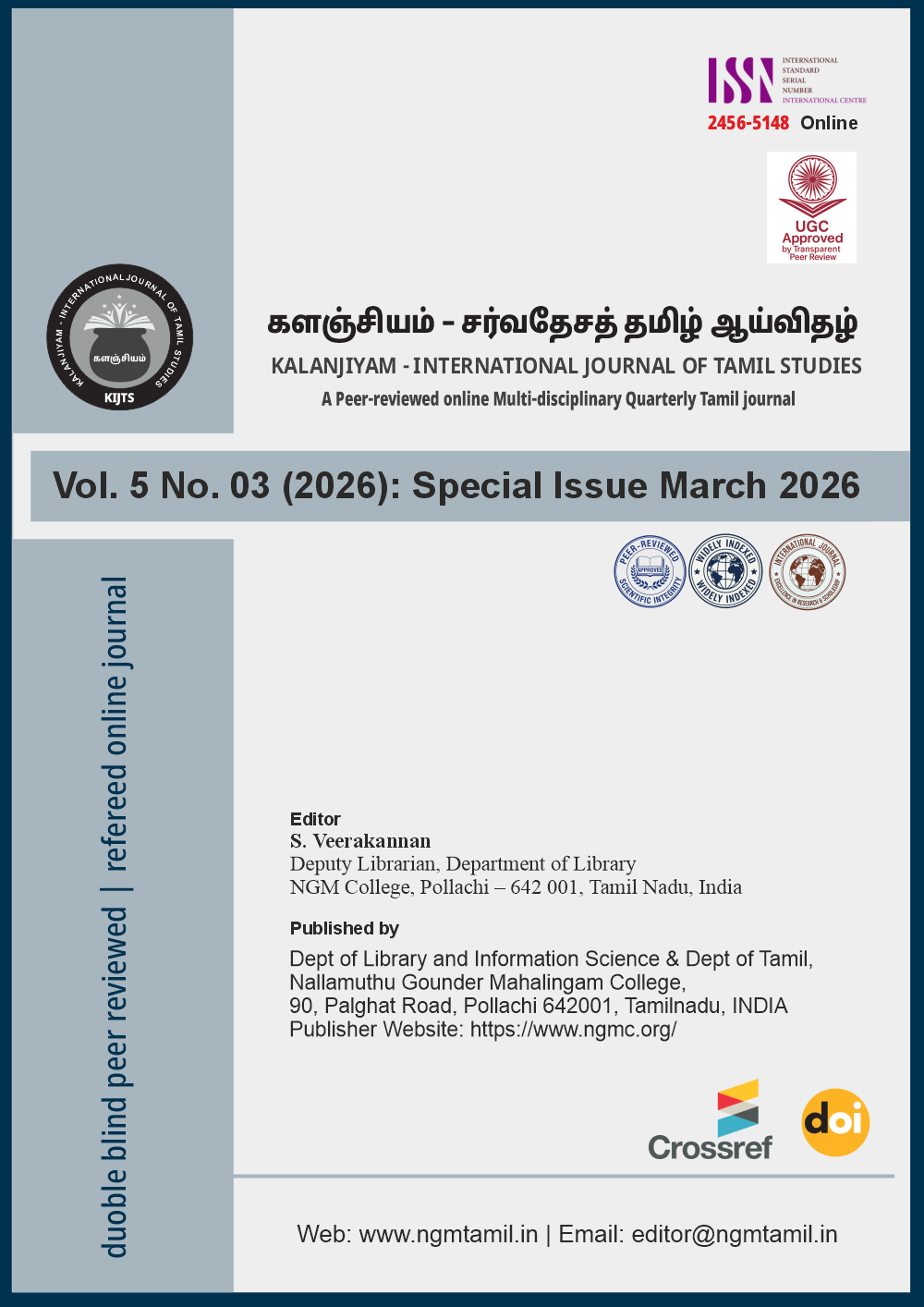
Editor:
S.VEERAKANNAN
Deputy Librarian, NGM College, Pollachi
Full Issue
Articles
-
சி.எம். முத்துவின் ‘கறிச்சோறு’ நாவல் காட்டும் கிராமப்புற சமூக அமைப்பு: ஒரு சமூகவியல் மற்றும் மானுடவியல் ஆய்வு Rural Social Structure in C.M. Muthu’s Novel ‘Karichoru’: A Sociological and Anthropological Study
K. Kowsalya PhD Research Scholar, Department of Tamil, Annamalai University, Annamalainagar - 608002, Chidambaram, Cuddalore District, Tamil Nadu, India. India , Dr. V. Karthik Assistant Professor, Department of Tamil, Annamalai University, Annamalainagar - 608002, Chidambaram, Cuddalore District, Tamil Nadu, India IndiaIn the history of Tamil literature, regional literature serves as an exceptional document revealing the internal facets of society. In particular, C.M. Muthu’s novel Karichoru extensively records the local essence of the Thanjavur district and the intricate caste hierarchies prevalent there.
This article examines, from a sociological perspective, the sub-sects of the Kallar community depicted in the novel, the power struggles between them, the violence perpetrated in the name of 'Vaagarai Gauravam' (Lineage Honor), and the patriarchal tendencies within a land-owning society. Furthermore, by comparing it with the short story Karichoru by Ki. Rajanarayanan (the father of Karisal literature), this study provides a detailed analysis of how 'food' (Karichoru or meat-rice) serves as a symbol of social status and an indicator of poverty across two different terrains of Tamil Nadu. This work sheds light on how rural power centers utilize caste as a tool and how it dismantles individual relationships and love.
Pages: 1-10Views: 0 Downloads: 00 0K. Kowsalya (1), Dr. V. Karthik (2)- (1) PhD Research Scholar, Department of Tamil, Annamalai University, Annamalainagar - 608002, Chidambaram, Cuddalore District, Tamil Nadu, India.
- (2) Assistant Professor, Department of Tamil, Annamalai University, Annamalainagar - 608002, Chidambaram, Cuddalore District, Tamil Nadu, India
சங்க காலத்தில் உலோகவியல் தொழில்நுட்பம் Metallurgical Technology in the Sangam Age
Dr. A. Jayaganesh Assistant Professor, Department of Tamil, Anand Institute of Higher Technology, Kazhipattur, Chennai – 603103. IndiaThis article explores the advanced metallurgical knowledge and technological prowess of the ancient Tamils during the Sangam period. By synthesizing evidence from classical Sangam literature—such as Tolkappiyam, Purananuru, and Akananuru—with modern archaeological findings from sites like Adichanallur, Kodumanal, and Mayiladumparai, the study demonstrates that Tamils were pioneers in metalworking. The research details the extraction and processing of various metals including gold, silver, copper, and iron, highlighting the sophisticated techniques used to create tools, weapons, and intricate jewelry. Notably, the article cites archaeological evidence dating iron usage in Tamil Nadu back to 3345 BCE, suggesting that the Tamils were among the first in the world to enter the Iron Age and master the production of high-quality steel and specialized "Beta Bronze".
Pages: 180-190Views: 0 Downloads: 00 0Dr. A. Jayaganesh (1)- (1) Assistant Professor, Department of Tamil, Anand Institute of Higher Technology, Kazhipattur, Chennai – 603103., India
180-190எஸ். ராமகிருஷ்ணன் நாவல்களில் சிறுதெய்வங்கள் Folk deities in S. Ramakrishnan Novels
Santhanalakshmi G Part-Time Research scholar, (Reg.No: BDU2120632779355), BDU/PhD/20/0456, Dated: 04.09.2020 Bishop Heber College (Autonomous), Affiliated to Bharathidasan University, Tiruchirappalli – 02 India , Dr J. Aruna Assistant professor, Department of Tamil, Bishop Heber College (Autonomous A++), Affiliated to Bharathidasan University, Trichy, Tamilnadu, India. IndiaThe proverb states, “One should not reside in a village without a temple.” People believe that if good things happen in their lives, it is due to the grace of God, and if bad things occur, they are due to the anger of God. In this way, we can understand that rural people worship folk deities with a sense of faith mixed with fear.
In the beginning, nature worship emerged due to fear of natural forces. Later, as religion developed, forms of worship evolved into the worship of major deities, while the worship of minor (folk) deities continued among rural people. Thus, religious belief developed through various stages. Folk deities are referred to as minor deities. This system includes several types, such as clan deity worship, family deity worship, and village deity worship.
This study is structured to explain the ideas related to the worship of minor deities as presented in the novels of S. Ramakrishnan.
Pages: 191-198Views: 0 Downloads: 00 0Santhanalakshmi G (1), Dr J. Aruna (2)- (1) Part-Time Research scholar, (Reg.No: BDU2120632779355), BDU/PhD/20/0456, Dated: 04.09.2020 Bishop Heber College (Autonomous), Affiliated to Bharathidasan University, Tiruchirappalli – 02, India
- (2) Assistant professor, Department of Tamil, Bishop Heber College (Autonomous A++), Affiliated to Bharathidasan University, Trichy, Tamilnadu, India.
191-198சி பாமாவின் படைப்புகளும் செயல்பாடும்: ஒரு விரிவான தலித் பெண்ணிய ஆய்வு Bama’s Works and Activism: A Comprehensive Dalit Feminist Study
A. Illayaraja Ph.D. Research Scholar, Government Arts College (Autonomous), Kumbakonam, India , Dr. K. Anbumani Associate Professor, Government Arts College (Autonomous), Kumbakonam IndiaBama is a pioneer who took Dalit Feminist theory and the aesthetics of the oppressed people to a global level within the landscape of Tamil literature. This article subjects Bama's life history, her literary journey, and her social activism to a comprehensive study. Born as Faustina Mary Fatima Rani, Bama—as a Dalit Christian woman—has used her works to place the caste and gender oppression she faced before the conscience of society.
While her novel Karukku begins as an individual’s history, it evolves into a ‘Testimonio’ depicting the collective trauma of a community. In the novel Sangati, Bama records the labor of Dalit women, their resistance against violence, and their culture of rebellion. The novel Vanmam courageously explores the sub-sectarian conflicts existing within Dalit communities. Bama’s linguistic style transcended the grammatical boundaries of traditional Tamil, gaining literary recognition for the regional dialects and profanities of marginalized people. This article provides a detailed perspective on power, resistance, language, and social change as reflected in her works.
Pages: 11-24Views: 0 Downloads: 00 0A. Illayaraja (1), Dr. K. Anbumani (2)- (1) Ph.D. Research Scholar, Government Arts College (Autonomous), Kumbakonam,, India
- (2) Associate Professor, Government Arts College (Autonomous), Kumbakonam, India
11-24நடன அபிநயத்தின் ஊடாக திணை இலக்கியத்தின் சிருங்கார ரஸம் வெளிப்பாடு The Expression of Love in Tinai Literature through Dance Abhinaya
Dr. Thakshayiny Paramadevan Senior Lecturer in Dance, Swamy Vipulananda Institute OfAesthetic Studies, Eastern University Srilanka. IndiaIn Tamil Sangam literature, the Akam (interior) poems portray the subtle emotions of human love in close association with nature. Through the five landscapesKurinji, Mullai, Marutham, Neithal, and Palai various phases of love such as union, waiting, conflict, separation, and longing are delicately expressed. These emotional states correspond to what is known in Indian aesthetic theory as Srinrara Rasa (the sentiment of love).In classical dance forms, especially Bharatanatyam, these emotions of love are brought to life on stage through Abhinaya (expressive techniques). The integration of Angika (body movements), Vachika (verbal elements), Aharya (costume and adornment), and Sattvika (inner emotional expression) enables the portrayal of Nayaka–Nayaki (hero–heroine) bhavas. Through facial expressions, hand gestures, and bodily movements, the emotional essence of love is effectively communicated to the audience.Thus, the love expressed in Tinai literature through poetic language is transformed into a visual and performative experience in dance. This study explores the relationship between the emotional expressions found in Tinai literature and their representation through dance abhinaya, highlighting the shared aesthetic foundation of literature and performance.
Pages: 25-38Views: 0 Downloads: 00 0Dr. Thakshayiny Paramadevan (1)- (1) Senior Lecturer in Dance, Swamy Vipulananda Institute OfAesthetic Studies, Eastern University Srilanka., India
25-38சோழர் கால ஏரி, குளம், மதகு மற்றும் குமிழித் தூம்பிகளின் வடிவமைப்பு, செயல்முறை, அறிவியல் தொழில்நுட்ப நுணுக்கம் மற்றும் பண்பாட்டு ஆய்வு A Study on the Design, Operational Methods, Scientific-Technical Nuances, and Cultural Aspects of Lakes, Ponds, Sluices, and 'Kumizhi Thoombu' (Silt-Ejecting Sluices) of the Chola Period
Dr. R.Suresh Department of Tamil, Mahendra Engineering College Mallasamudram, Namakkal. India , Dr. M.Muthuvinayagam Department of EEE, Mahendra Engineering College Mallasamudram, Namakkal. IndiaThe Chola period stands as a Golden Age in the history of irrigation for the Tamils. The world-renowned hydraulic structures of this era were not merely constructions but a manifestation of the scientific thinking of ancient Tamils toward sustainable development. This research report extensively analyzes the design, operational methods, and socio-economic impacts of the unique technology used during the Chola period known as 'Kumizhi Thoombu' (Sluice with Silt Ejectors).
Through archaeological evidence, inscriptions, and literary data, it is explained how these sluices served as pioneering systems in hydraulic pressure control and sediment management. Furthermore, detailed data is provided on how water bodies were systematically maintained through an autonomous body called 'Eri Variyam' (Lake Committee) and the manner in which committee members were elected via the 'Kudavolai' system. A central theme of this research is how this technology aligns with modern engineering concepts such as the Venturi Effect and Bernoulli's Principle.
Pages: 39-49Views: 0 Downloads: 00 0Dr. R.Suresh (1), Dr. M.Muthuvinayagam (2)- (1) Department of Tamil, Mahendra Engineering College Mallasamudram, Namakkal., India
- (2) Department of EEE, Mahendra Engineering College Mallasamudram, Namakkal., India
39-49சங்க இலக்கியத்தில் அக வாழ்வு: ஒரு பன்முகப் பண்பாட்டு, சமூகவியல் மற்றும் உளவியல் ஆய்வு Interior Life in Sangam Literature: A Multi-faceted Cultural, Sociological, and Psychological Study
Dr. K. Kalimuthu Assistant Professor, Department of Tamil, PERI Arts & Science College, Mannivakkam. Chennai -48 IndiaSangam literature serves as a two-thousand-year-old cultural identity for Tamils and stands as a unique treasure within the ranks of world classical literature. Sangam poets categorized human life into two major divisions—Akam (Interior/Private) and Puram (Exterior/Public)—recording the nuances of interior life through sophisticated literary techniques.
This research paper explores how "Akam" life in Sangam literature is not merely an expression of romantic emotions, but a framework built upon social discipline, land-based lifestyles, and psychological structures. It analyzes how interior life is constructed through the theories of Ainthinai (the five landscapes), Mutharporul (Space and Time), Karupporul (Environment/Attributes), and Uripporul (Human Emotions/Action). Furthermore, it examines how literary devices such as Ullurai Uvamam (Inherent Metaphor) and Iraichi (Implicit Suggestion) are utilized to express emotions. By comparing Sangam Akam poems with modern psychological and sociological theories, this paper establishes their timeless significance.
சங்க இலக்கியம் என்பது தமிழரின் இரண்டாயிரம் ஆண்டு காலப் பண்பாட்டு அடையாளமாகவும், உலகச் செவ்வியல் இலக்கிய வரிசையில் தனித்துவமான இடத்தைப் பெற்றுள்ள ஒரு கருவூலமாகவும் திகழ்கிறது. மனித வாழ்வியலை ‘அகம்’ மற்றும் ‘புறம்’ என இரு பெரும் பிரிவுகளாகப் பகுத்து, அதில் அக வாழ்வை மிக நுட்பமான இலக்கிய உத்திகளுடன் சங்கப் புலவர்கள் பதிவு செய்துள்ளனர்.1 இந்த ஆய்வுக்கட்டுரை, சங்க இலக்கியத்தில் அக வாழ்வு என்பது வெறும் காதல் உணர்ச்சிகளின் வெளிப்பாடு மட்டுமல்லாமல், அது ஒரு சமூக ஒழுக்கம், நிலம் சார்ந்த வாழ்வியல் மற்றும் உளவியல் சார்ந்த கட்டமைப்பு என்பதை விரிவாக ஆராய்கிறது. ஐந்திணைக் கோட்பாடுகள், முதற்பொருள், கருப்பொருள், உரிப்பொருள் ஆகியவற்றின் வாயிலாக அக வாழ்வு எவ்வாறு கட்டமைக்கப்பட்டுள்ளது என்பதையும், உள்ளுறை உவமம் மற்றும் இறைச்சி போன்ற இலக்கிய உத்திகள் உணர்ச்சிகளை வெளிப்படுத்தும் விதத்தையும் இது பகுப்பாய்வு செய்கிறது.2 மேலும், நவீன உளவியல் மற்றும் சமூகவியல் கோட்பாடுகளுடன் சங்க அகப் பாடல்களை ஒப்பிட்டு, அவற்றின் காலங்கடந்த முக்கியத்துவத்தை இக்கட்டுரை நிறுவுகிறது.
Pages: 50-59Views: 0 Downloads: 00 0Dr. K. Kalimuthu (1)- (1) Assistant Professor, Department of Tamil, PERI Arts & Science College, Mannivakkam. Chennai -48, India
50-59பண்பாட்டு மானிடவியல் மற்றும் சமூக வரலாற்றுப் பின்னணியில் பேராசிரியர் தொ. பரமசிவனின் ஆய்வு முறையியல்: ஒரு பன்முகப் பார்வை Research Methodology of Professor Tho. Paramasivan in the Context of Cultural Anthropology and Social History: A Multidimensional Perspective
Dr. S. Maharajan Associate Professor, Department of Tamil, Peri College of Arts and Science, Manniivakkam, Chennai – 600048 IndiaProfessor Tho. Paramasivan (Tho. Pa.) created a new genre of historical perspective within the landscape of Tamil research during the late twentieth century. This article extensively examines his research methodology through the lens of a "multidimensional literary perspective." Moving beyond traditional histories centered on the ruling class, his approach—which focuses on the lifestyle of subaltern (grassroots) people and their material culture—is identified as "Bottom-up History." This paper analyzes Tho. Pa.’s specific research techniques, such as:
- Comparing epigraphical (inscription) data with Sangam literature.
- Approaching the human values embedded in Bhakti literature from a populist viewpoint.
- Identifying Tamil nationalist politics through the epic Silappathikaram.
Furthermore, this study traces how Tho. Pa. fits into Antonio Gramsci’s concept of the "Organic Intellectual" and explores how his seminal works, Alagar Koil and Ariyappadatha Thamizhagam (Unknown Tamil Nadu), brought the hidden facets of Tamil society to light.
Pages: 60-69Views: 0 Downloads: 00 0Dr. S. Maharajan (1)- (1) Associate Professor, Department of Tamil, Peri College of Arts and Science, Manniivakkam, Chennai – 600048, India
60-69நந்திக் கலம்பகத்தின் வரலாறும் புராணச்செய்திகளும் The History and Mythological References in Nandikkalambakam
Dr. A. Mahaboob Assistant Professor, Department of Tamil, NGM College, Pollachi. IndiaThere is a traditional legend surrounding the composition of Nandikkalambakam. Nandivarman’s father had two wives. Nandivarman was the son of the first wife, while the second wife had four sons, all younger than him. When Nandivarman reached youth, his father passed away. Consequently, Nandivarman drove away his four younger brothers and crowned himself king. It is believed that one of these four brothers is the author of this work.
The four exiled brothers decided to reclaim the throne. To achieve this, one mastered magic (mantra), one learned strategy (tantra), another perfected swordsmanship, and the fourth mastered Tamil literature to the point of composing "Aram" (poetry with a lethal intent/curse). Eventually, the four brothers united and waged war against Nandivarman but were defeated. Following this defeat, it is said that this book was composed using "Aram" verses, which ultimately led to Nandivarman's death. This article explores not only the history of Nandivarman but also the abundance of mythological references found within this text.
Pages: 70-76Views: 0 Downloads: 00 0Dr. A. Mahaboob (1)- (1) Assistant Professor, Department of Tamil, NGM College, Pollachi., India
70-76நற்றிணைப் பாடல்களில் உள்ளுறை உவமக் கட்டமைப்புகள்: ஒரு விரிவான பகுப்பாய்வு Categorical Analysis of Implied Metaphors in Narrinai: An In-depth Research
T. Nandhinipriya Full-time Ph.D. Research Scholar (Reg No: BDU2210632780197) Department of Tamil, Kunnthavai Naacchiyaar Govt. Arts College for Women (A), Affiliated with Bharathidasan University, Thanjavur - 613007, Tamil Nadu, India. India , Dr. S. Periyanayaki Research Guide & Associate Professor, Department of Tamil, Kunnthavai Naacchiyaar Govt. Arts College for Women (A), Affiliated with Bharathidasan University, Thanjavur - 613007, Tamil Nadu, India. IndiaThe excellence, utility, and evolution of a language are deeply interconnected with the activities of the society that speaks it. In the history of the world, numerous languages have perished or been eroded by the turning wheels of time. In such a context, Tamil stands as an unparalleled classical language that has survived for thousands of years. The grammatical treatise Tolkappiyam and ancient Sangam literature serve as the jewels that polish this unique language. In Narrinai, one of the Sangam anthologies, human internal emotions (Akam) are depicted as being inextricably linked with nature. Specifically, the technique of 'Ullurai Uvamam' (Implicit Metaphor)—where the thoughts and feelings of the characters are not stated directly but are conveyed through the hidden meanings within natural descriptions—is sublime. This study examines the five types of Ullurai Uvamam as defined by Tolkappiyar, applying them to the poems of Narrinai to explore their literary beauty and social impact in detail. Using Tolkappiyam and Narrinai as primary sources and supported by secondary texts, the objective of this article is to explain the typological perspective of implicit metaphors.
Pages: 77-86Views: 0 Downloads: 00 0T. Nandhinipriya (1), Dr. S. Periyanayaki (2)- (1) Full-time Ph.D. Research Scholar (Reg No: BDU2210632780197) Department of Tamil, Kunnthavai Naacchiyaar Govt. Arts College for Women (A), Affiliated with Bharathidasan University, Thanjavur - 613007, Tamil Nadu, India.
- (2) Research Guide & Associate Professor, Department of Tamil, Kunnthavai Naacchiyaar Govt. Arts College for Women (A), Affiliated with Bharathidasan University, Thanjavur - 613007, Tamil Nadu, India.
77-86சாகித்திய அகாதெமி விருது பெற்ற தமிழ்க் கவிதைகளில் உத்திகள் Techniques in Sahitya Akademi Award-Winning Tamil Poems
G. Nirbankumar Reg. No: BDU2220632780050, Part-time Doctoral Research Scholar Ganesar College of Arts and Science, Melaishivapuri - 622 403, Pudukkottai District. Affiliated with Bharathidasan University. India , Dr. V. A. Palaniappan Principal & Research Guide, Ganesar College of Arts and Science, Melaishivapuri - 622 403, Pudukkottai District. Affiliated with Bharathidasan University. IndiaEvery field has its own unique set of techniques. In literature—specifically in modern poetry (Pudhukkavithai)—numerous techniques are found, such as simile, metaphor, imagery, symbolism, irony, paradox, satire, myth, pun (double entendre), dialogue, imagination, grammar, repetition, intertextuality, grammatical authority, folk elements, and ambiguity. These techniques play a major role in expressing the core theme of a poem.
The thoughts of E. Sundaramoorthy are worth comparing here:
"Literature does not shine through its message alone. It gains brilliance and life through its power of expression. Literary essence lies not in the subject matter, but in the skill of conveying it."
- P. Aravaanan highlights the significance of technique as a method of expression:
"In the history of Tamil poetry, form once ruled supreme. When it did, the method of expression gained life. That life is the arrival and existence of modern poetry; the method of expression is the very heartbeat of a poem." This article examines how these techniques are employed in Tamil poems that have received the Sahitya Akademi Award.
Pages: 87-106Views: 0 Downloads: 00 0G. Nirbankumar (1), Dr. V. A. Palaniappan (2)- (1) Reg. No: BDU2220632780050, Part-time Doctoral Research Scholar Ganesar College of Arts and Science, Melaishivapuri - 622 403, Pudukkottai District. Affiliated with Bharathidasan University., India
- (2) Principal & Research Guide, Ganesar College of Arts and Science, Melaishivapuri - 622 403, Pudukkottai District. Affiliated with Bharathidasan University., India
87-106யோகா: நிலையான மனித மேம்பாட்டிற்கான முழுமையான தளம் - ஒரு விரிவான ஆய்வு Yoga: A Holistic Platform for Sustainable Human Development – A Comprehensive Study
Dr. K. Santhi Assistant Professor, Department of Human Excellence, NGM College, Pollachi – 642001 IndiaYoga is an ancient holistic practice originating from the deep roots of Indian philosophy. By integrating physical health, mental clarity, emotional balance, and ethical conduct, it provides a comprehensive foundation for long-term human development. In the modern era, global development is often measured solely based on Gross Domestic Product (GDP) and technological advancements. Such external growth models neglect the inner well-being of individuals, resulting in widespread stress, environmental degradation, and social inequalities.
By addressing both the internal and external aspects of life, Yoga serves as a fundamental tool for achieving the United Nations' Sustainable Development Goals (SDGs). Yogic techniques such as Asanas, Pranayama, and meditation enhance emotional regulation and calm the nervous system. Furthermore, the ethical principles of Yoga (Yama and Niyama) encourage compassion, environmental awareness, and responsible consumption habits among individuals.
By integrating Yoga into education, healthcare, and corporate environments, a mindful and sustainable culture can be created. This research paper explores in detail how Yoga acts as a bridge toward global peace and sustainability through individual transformation.
Pages: 107-120Views: 0 Downloads: 00 0Dr. K. Santhi (1)- (1) Assistant Professor, Department of Human Excellence, NGM College, Pollachi – 642001, India
107-120அறிவியல் புனைவும் சூழலிய மானிடவியலும் Eco-humanist Perspectives in Science Fiction
V. Revathi Full-time Ph.D. Research Scholar, Department of Tamil, Madras Christian College (MCC), Tambaram, Chennai - 600059. India , Dr. D. Meshak Research Guide, Head of the Department of Tamil, Madras Christian College, Tambaram, Chennai - 600059. IndiaIn the landscape of twentieth-century Tamil literature, science fiction has evolved beyond merely constructing imaginary worlds. It has emerged as a rich field of thought that explores various human concerns such as philosophy, social transformation, and environmental issues. Contemporary Tamil writers are integrating scientific advancements with social realities, producing works that provoke reflection on the future of human life. In this context, the writer Tamilmagan has demonstrated a distinctive creative approach by incorporating sociological and ecological perspectives into his science fiction works, thereby highlighting the complexities of the human–nature relationship. The short story “Klimidon” can be seen as a significant literary text that employs the science fiction genre to examine humanity’s dominating attitude towards nature and its consequences. This analytical study proposes to approach the text through the theoretical framework of “Eco-humanism,” examining how the relationship between humans and nature is being re-evaluated. It further explores how modern scientific developments and technological advancements are disrupting this relationship, and how urbanization and industrial growth are leading to the exploitation of rural communities and natural resources.
Pages: 121-129Views: 0 Downloads: 00 0V. Revathi (1), Dr. D. Meshak (2)- (1) Full-time Ph.D. Research Scholar, Department of Tamil, Madras Christian College (MCC), Tambaram, Chennai - 600059., India
- (2) Research Guide, Head of the Department of Tamil, Madras Christian College, Tambaram, Chennai - 600059., India
121-129தலைமுறைகள், ஏற்கனவே சொல்லப்பட்ட மனிதர்கள் - ஓர் ஒப்பீடு யதார்த்தவியல், மீயதார்த்தவியல் அடிப்படையில் Talaimuraikal, Erkanave Sollappatta Manitharkal – Oor Oppidu Yathaarttaviyal, Miyathaarttaviyal Adippataiyil.
S. Gowtham Research Scholar, Depertment of Tamil Language And Translation studies, Dravidian University, Kuppam -517426 IndiaSome novelists craft their work with a primary focus on realism, while others center their narratives around specific theoretical frameworks. Both approaches create distinct impacts on the reader's psyche. This essay explores this dichotomy as its central theme. By analyzing and contrasting these two literary styles, the essay highlights the strengths and weaknesses inherent in both approaches.
நாவல்களை சில எழுத்தாளர்கள் யதார்த்தமாகவும் சில எழுத்தாளர்கள் கோட்பாடுகளை மையமாக வைத்தும் எழுதுகிறார்கள். இரண்டு வகை எழுத்துக்களும் இரண்டு வகையான விளைவுகளை வாசிப்பவர் மனதில் ஏற்படுத்துகிறது. இதையே தன் ஆய்வின் மையமாகக் கொண்டு எழுதப்பட்டுள்ளது இக்கட்டுரை. இருவேறு வகைப்பட்ட படைப்புகளை எடுத்துக்கொண்டு அவற்றிற்கிடையேயான ஒற்றுமைகளையும் வேற்றுமைகளையும் அலசி ஆராய்வதால் இரண்டு தரப்புகளின் நிறை குறைகளை இக்கட்டுரை சுட்டிக்காட்டுகிறது.
Pages: 130-140Views: 0 Downloads: 00 0S. Gowtham (1)- (1) Research Scholar, Depertment of Tamil Language And Translation studies, Dravidian University, Kuppam -517426, India
130-140சங்க இலக்கியத்தில் மழவர் The Mazhavar in Sangam Literature
Dr. C. Parameswari Associate Professor, Tamil Research Centre, Alagappa Government Arts College, Karaikudi-3. IndiaThis research explores the historical and cultural significance of the Mazhavar community as depicted in Sangam Literature. Residing in the Mazhanadu region between the Kolli Hills and the Kollidam River, the Mazhavar were a martial community renowned for their distinct aesthetics, including curly hair adorned with Kadamba flowers and peacock feather garlands. The study highlights their military prowess, specifically their expertise in archery and the maintenance of elephant and horse cavalries. Key cultural practices are examined, such as the Poondhodai festival for martial graduation and the tactical use of termite mound soil to remain silent during night raids. Furthermore, the paper discusses their leadership under figures like Athiyaman Neduman Anji and Valvil Ori, their ritualistic sacrifices to the goddess Kotravai, and their lifestyle as both warriors and highway robbers.
Pages: 141-154Views: 0 Downloads: 00 0Dr. C. Parameswari (1)- (1) Associate Professor, Tamil Research Centre, Alagappa Government Arts College, Karaikudi-3., India
141-154சிவவாக்கியர் மற்றும் வேதாத்திரி மகரிஷி கூறும் காயகற்ப தத்துவம் - ஒப்பீடு Sivavakkiyar and Vethathiri Maharishi’s Kayakalpa Philosophy – A Comparison
K. Santhi Assistant Professor Department of Human Excellence Nallamuthu Gounder Mahalingam College Pollachi IndiaThis research paper analytically compares the Kayakalpa philosophy of the prominent Tamil Siddhar Sivavakkiyar and the modern yogic philosopher Vethathiri Maharishi, examining them through psychological and scientific lenses.
Kayakalpa is regarded as a holistic way of life that enhances physical health, mental peace, and spiritual progress by integrating the body, mind, and life-force energy. Sivavakkiyar explains Kayakalpa as a renunciatory spiritual path to attain the state of wisdom (Gnana) by controlling desires, lust, and mental impurities. Conversely, Vethathiri Maharishi frames it as a scientifically-oriented yogic practice that achieves body-mind integration through the protection of life-force (bio-magnetic energy), Ojas transformation, and meditation.
By critically analyzing the similarities and differences between these two approaches, this paper emphasizes that Kayakalpa is not merely an ancient traditional knowledge system but an integrated lifestyle capable of addressing the physical and mental health challenges of modern humanity.
Pages: 155-165Views: 0 Downloads: 00 0K. Santhi (1)- (1) Assistant Professor Department of Human Excellence Nallamuthu Gounder Mahalingam College Pollachi, India
155-165துயில் நாவலில் குறிப்பிடப்படும் நாட்டுப்புற நம்பிக்கைகள் The folk beliefs described in the novel Thuyil
Santhanalakshmi G Part-Time Research scholar, Department of Tamil, Bishop Heber College (Autonomous A++), Affiliated to Bharathidasan University, Trichy, Tamilnadu, India. India , Dr J. Aruna Research Guide, Assistant professor, Department of Tamil, Bishop Heber College (Autonomous A++), Affiliated to Bharathidasan University, Trichy, Tamilnadu, India. IndiaIt is not possible to determine exactly when beliefs originated in human life. However, these beliefs play such a significant role that they can be said to guide human life itself. We can observe that these beliefs continue to persist in people’s everyday lives. Many ritual practices have emerged based on these beliefs. Together, they form an integral part of the emotional fabric of a society’s culture. Some of these folk beliefs have been recorded by S. Ramakrishnan in his novel Thuyil. This study aims to explain and elaborate on those beliefs.
Pages: 174-179Views: 0 Downloads: 00 0Santhanalakshmi G (1), Dr J. Aruna (2)- (1) Part-Time Research scholar, Department of Tamil, Bishop Heber College (Autonomous A++), Affiliated to Bharathidasan University, Trichy, Tamilnadu, India.
- (2) Research Guide, Assistant professor, Department of Tamil, Bishop Heber College (Autonomous A++), Affiliated to Bharathidasan University, Trichy, Tamilnadu, India.
174-179அட்டப்பாடி பகுதி இருளர் பழங்குடியினரின் பண்பாட்டு மாற்றங்களும் சடங்கியல் மரபுகளும் Cultural Transformations in the Ritual Practices of the Irula Tribe of Attappadi
Dhanalaksmi R Ph. D Research Scholar (Part - time), Department of Tamil, N.G.M. College , Pollachi. India , Dr.T.Parameshwari Associate Professor,HOD, Department of Tamil, N.G.M. College, Pollachi. IndiaThe Irula tribe is one of the ancient indigenous communities inhabiting the regions of the Western Ghats in South India, particularly in Tamil Nadu and Kerala. Traditionally, the Irula people have depended on forests and hill ecosystems for their livelihood and have developed rich indigenous knowledge systems along with distinctive ritual practices. However, rapid socio-economic changes, land alienation, modernization, and increased interaction with mainstream societies have gradually influenced their traditional way of life. These developments have led to noticeable transformations in their cultural traditions and ritual practices. The loss or modification of such indigenous traditions represents not only a change within the community but also a broader cultural concern. In this context, the present study examines the cultural transformations that have occurred in the ritual practices of the Irula community residing in Karuvadam hamlet in the Attappadi region. Adopting an ethnographic approach, the study documents ritual elements and analyses the social and cultural factors that have contributed to these changes over time.
Pages: 166-172Views: 0 Downloads: 00 0Dhanalaksmi R (1), Dr.T.Parameshwari (2)- (1) Ph. D Research Scholar (Part - time), Department of Tamil, N.G.M. College , Pollachi., India
- (2) Associate Professor,HOD, Department of Tamil, N.G.M. College, Pollachi., India
166-172Journal Info
Information
ADDITIONAL MENU
- Editorial Policies
- Peer Review Policy
- Peer Review Process
- Open Access Policy
- License agreement
- Licensing Policy
- Article Processing Fee
- Recommended Reviewer
- Complaint Policy
- Ethical & Malpractice Policies
- Advertising Policy
- Licenses, Copyright & Permissions
- Peer Review & Publication Policies
- Article Retraction & Withdrawal Policy
- Policies on Conflict of Interest and Informed Consent
- Privacy Statement
- Editorial Policies
- PLAGIARISM POLICY
Contact Address
Submit & Technical Contact
S.VEERAKANNAN
E-Mail: editorial.kalanjiyam@ngmc.org
Mobile: 9788175456
NGM College, 90, Palghat Road, Pollachi 642001, Tamilnadu, INPublisher
Kalanjiyam - International Journal of Tamil Studies
களஞ்சியம் - சர்வதேச தமிழ் கல்வி ஆராய்ச்சி இதழ்
Dept of Library and Information Science & Dept of Tamil,
Nallamuthu Gounder Mahalingam College,
90, Palghat Road, Pollachi 642001, Tamilnadu, INDIA
Publisher Website: https://www.ngmc.org/
Kalanjiyam களஞ்சியம் - சர்வதேச தமிழ் கல்வி ஆராய்ச்சி இதழ் eISSN: 2456-5148 - Dept of Library and Information Science & Dept of Tamil, NGM College, Pollachi 642001
Sanguline Theme by Sangu Ilmu