
Journal title (In Regional) களஞ்சியம் - சர்வதேச தமிழ் ஆய்வு இதழ்
Journal title (In English) KALANJIYAM – International Journal of Tamil Studies
Publication language Tamil (தமிழ்), English, Abstract and References in English
Abbreviated key-title: KALANJIYAM - KIJTS
Publishing frequency Quarterly (February, May, August, and November)
E-ISSN 2456-5148
DOI registered Tamil Journal
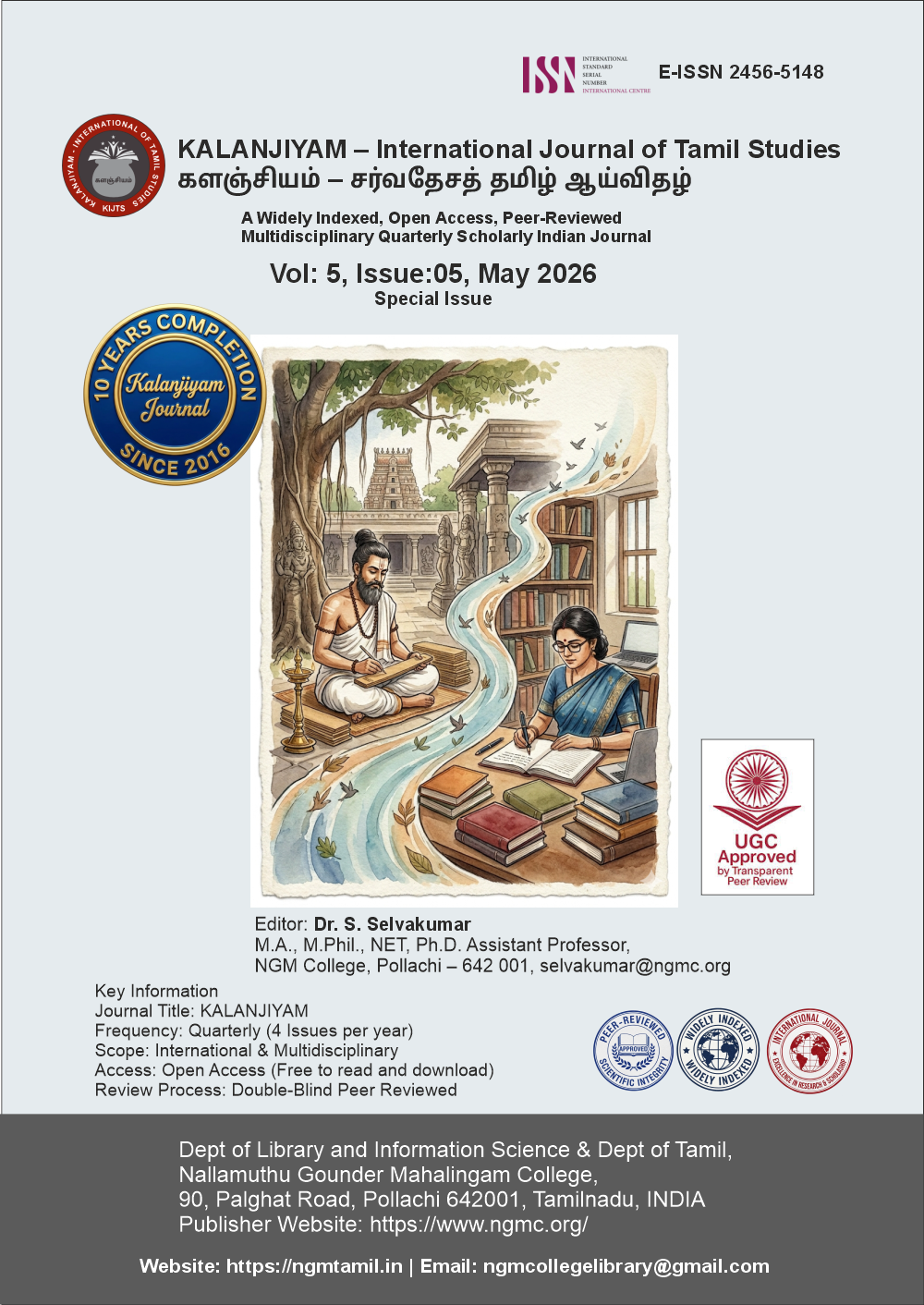
Vol. 5 No. 05 (2026): Kalanjiyam May 2026 - Special Issue
Articles
-
திருக்குறளில் மனிதநேயச் சிந்தனைகள் Humanistic thoughts in Thirukkural
Dr. K. Veerathamilan Assistant Professor in Tamil, Department of Science and Humanities, Sri Muthukumaran Institute of Technology, Chennai-69 IndiaHumanism means treating fellow human beings as one’s own self and showing them love, compassion, and respect. It is considered the fundamental principle of human life, transcending all boundaries of race, religion, language, and nation. When observing and researching the antiquity of the Tamil language and the Tamil race, it is evident that Tamil literature has consistently emphasized through the ages that living in unity by casting aside differences is the ideal path. Therefore, it can be said that Tamil literatures serve as the very fountainhead of humanism. The Tirukkural, which holds an unparalleled place in the Tamil literary tradition, expounds universal life principles for all of humanity, transcending differences of religion, language, caste, and race. Noble qualities such as individual virtue, social responsibility, altruism, compassion, and charity are explained in this book as the foundation of humanism. The entire essence of the Tirukkural is rooted in humanistic thought. Consequently, this article aims to analyze the humanistic ideas emphasized by Thiruvalluvar with the goal of elevating the human psyche and social life.
Pages: 1-9Views: 0 Downloads: 0சு.வேணுகோபால் படைப்புகள் உணர்த்தும் “வேளாண்மை வாழ்வியல்” "Agricultural Life" as Depicted in the Works of Su. Venugopal
M. Vinoth PhD Research Scholar, Department of Tamil, Thiagarajar College, Madurai-09. India , Dr. R. Govindaraj Research Guide & Assistant Professor, Department of Tamil, Thiagarajar College, Madurai-09. IndiaSu. Venugopal is a rising writer in modern literature. He documents the decay of rural life following industrialization and globalization, as well as the struggles of people deeply connected to the land. In his stories, farmers invest heavily in agriculture; however, due to the lack of sufficient rainfall, drought, the inability to secure fair prices for their produce, and the proliferation of new technologies, they are pushed into a position where they cannot repay the loans they have taken.
The reader learns through his stories that farmers are forced to sell their land—which they consider their very life—in fragments to repay these debts, eventually becoming landless laborers. To the older generation, agricultural land was viewed as life itself. Su. Venugopal profoundly documents how, in today’s climate, agricultural land is merely viewed in terms of square footage. As a solution for farmers facing these changing circumstances, Su. Venugopal proposes methods of managing modern agriculture in many of his stories.
Pages: 34-41Views: 0 Downloads: 0ஆண்டன்பெனி கவிதைகளில் பெண் உணர்வுகள் Female emotions in Antonbeny’s poems
N. Balamurugan Research Scholar (2), Ph.D. Research Scholar, Nallamuthugounder Mahalingam college, Pollachi, Coimbatore, Tamilnadu, India India , Dr. T. Rajkumar Associate Professor, Research Supervisor, Department of Tamil, Nallamuthu Gounder Mahalingam College, Pollachi, Coimbatore, India. IndiaThe prominent aspect of Anton Benny's poetry largely revolves around ordinary people and socially relevant thoughts. This constitutes one half of the poet's work. The other half of his poetry focuses on his mother who gave him life, his wife who shared his life, his daughter who became his life, and the simple women he observed and admired. He has written about the women he admired, and also about the women who influenced him. He has written about those he loved, and about those who loved him. He has written about the one who gave him life, and about the one who is his life. He has beautifully captured the emotions of women. The purpose of this article is to explore this collection of emotions.Keywords: Anton Benny's works, mother, wife, daughter, village women.
Pages: 42-53Views: 0 Downloads: 0அயல்நாட்டுத் திருமணமும் ராஜயோகம் தரும் இராகுவும்: ஜோதிடவியல் ஆய்வறிக்கை Foreign Marriage and the Rajayoga-Bestowing Rahu: An Astrological Research Report
Mr. K. Narasimhan Research scholar, Ph.D. Registration Number: UP24G9960004, Vels University. India , Prof. M. Mahalakshmi, M.A., M.Sc., Ph.D., Research guide and Research of Astrology Department, Vels University. IndiaIn Vedic astrology, although the shadow planet Rahu is generally classified as a malefic planet, it possesses the power to bestow unparalleled Rajayoga (princely fortune), authority, and foreign connections to the native through specific benefic placements and planetary combinations.
This paper analyzes the unique functions of Rahu, particularly the significance of the 3rd and 11th aspects emphasized in Pulippani Astrology, alongside the astrological rules that determine marriage in a foreign land. The connections of planets such as Rahu, Ketu, Venus, and the Moon with the 7th house (representing marriage), the 12th house (representing foreign lands), and the 9th house (the house of fortune/destiny) are discussed in detail.
Furthermore, based on the principles of traditional texts such as the Brihat Parashara Hora Shastra, Phaladeepika, and Jataka Parijata, this study extensively examines how these rules apply in practice through five sample horoscopes.
Pages: 34-42Views: 0 Downloads: 0ஐங்குறுநூற்றில் மருதத்திணையில் பெண்களின் நிலை: ஓர் இலக்கிய-சமூகவியல் பகுப்பாய்வு The Status of Women in the Marutham Thinai of Ainkurunuru: An Literary-Sociological Analysis
A.Revathi Full-time Ph.D. Research Scholar, Centre for Advanced Research in Tamil, Mannar Thirumalai Naicker College (Autonomous), Pasumalai, Madurai - 625004. India , Dr. K. Devibhooma Full-time Ph.D. Research Scholar, Centre for Advanced Research in Tamil, Mannar Thirumalai Naicker College (Autonomous), Pasumalai, Madurai - 625004. IndiaEttuthokai (The Eight Anthologies) and Pattupattu (The Ten Idylls) serve as the primary sources reflecting the lifestyle and social structure of the Sangam Tamils. Among these, Ainkurunuru, which intensely portrays interior (Akam) traditions within short poetic lines, depicts the inner emotions of the people against the backdrop of the five landscapes (Thinai).
The agricultural prosperity and economic advancement of the Marutham (riverine) region paved the way for the extramarital behavior of men, subsequently causing psychological tremors within the family structure. Based on the Marutham Thinai poems of Ainkurunuru composed by the poet Orampokiyar, this paper aims to examine the status and conditions faced by women within both the family structure and the social sphere.
This paper analyzes in detail the sociological and psychological states of the Thalaivi (the heroine) who stands as the center of domestic life; the Thozhi (the confidante) who supports her; and the Parathai (the courtesan) and Katharparathai (the mistress) who serve as men's companions of pleasure while simultaneously existing as individuals with distinct emotions. Furthermore, the life values, rights, and inner anguish of Marutham women—expressed through implied metaphors (Ullurai Uvamam), symbols, and historical records—are analyzed and compared with other Sangam literary evidence.
Pages: 54-66Views: 0 Downloads: 0நாட்டுப்புறக் காப்பியம் சிலப்பதிகாரம் Silappathikaram: A Folk Epic
Dr.G.Vadivelmurugan Assistant Professor & Head, Department of Tamil, Urumu Dhanalakshmi College, Tiruchirappalli - 620 019 Tamilnadu, India. IndiaLike the two sides of a coin, folk traditions and literature are fundamentally intertwined: literature is built upon the foundation of folk traditions, while folk traditions are, in turn, shaped by literary structures. This remains an undeniable aspect of both folk and literary traditions. In other words, oral traditions may be considered the primary source of literature, and oral songs can be viewed as the earliest precursors of literary forms, both logically and chronologically. Through this continuous process of exchange and transmission over time, the Silappatikaram, which narrates the story of Kannagi deeply rooted in Tamil society, is examined in this study as a folk epic. This constitutes the central focus of the present paper.
Pages: 67-77Views: 0 Downloads: 0தமிழ் - கன்னட இலக்கண வரலாறு A History of Tamil - Kannada Grammars
R. Brindha Ph.D. Research Scholar, Department of Tamil, Central University of Tamil Nadu, Thiruvarur – 610 005. India , Dr. P. Kumar Research Supervisor & Assistant Professor, Department of Tamil, Central University of Tamil Nadu, Thiruvarur – 610 005. IndiaTamil and Kannada are languages that belong to the Dravidian language family. In both these languages, literary works have been continuously produced throughout the ages. Grammarians categorize these literary works and compose grammars for them. While there are many reasons for the emergence of such a grammatical work, it is essential to document the grammatical texts that arise over time. History of grammar books identifies this. Accordingly, this article describes the grammatical works that have appeared in Tamil and Kannada over time from a historical perspective.
தமிழ் – கன்னடம் ஆகிய மொழிகள் திராவிட மொழிக் குடும்பத்தைச் சார்ந்த ஒரு மொழிக்குடும்ப மொழிகளாகும். இவ்விரு மொழிகளிலும் காலந்தோறும் இலக்கிய நூல்கள் எழுந்தவண்ணம் உள்ளன. இவ்விலக்கிய நூல்களை ஒருதிறப்படுத்தி அவற்றிற்கு இலக்கணம் எழுதுவர் இலக்கணிகள். இதுபோன்று ஒரு இலக்கணநூல் தோன்றுவதற்குப் பல காரணங்கள் உள்ளது எனினும், இவ்வாறு காலந்தோறும் எழும் இலக்கண நூல்களை ஆவணப் படுத்துவது அவசியமாகிறது. இதனை இலக்கண வரலாறு நூல்கள் அடையாளப்படுத்துகின்றன. இவ்வாறு தமிழ், கன்னட மொழிகளில் காலந்தோறும் தோன்றியுள்ள இலக்கண நூல்களை வரலாற்றியல் நோக்கில் இக்கட்டுரை எடுத்துரைக்கிறது.
Pages: 78-88Views: 0 Downloads: 0வைரமுத்து பாடல்களில் மொழி ஆளுமை: ஓர் இலக்கிய மற்றும் கணினிமொழியியல் பகுப்பாய்வு Language Mastery in the Songs of Vairamuthu: A Literary and Computational Linguistic Analysis
S. Kumaran Ph.D. Research Scholar, Department of Tamil, Thiru. Vi. Ka. Government Arts College, Thiruvarur. (Affiliated with Bharathidasan University, Tiruchirappalli). India , Dr. K. Chandran Associate Professor and Research Supervisor, Department of Tamil, Thiru. Vi. Ka. Government Arts College, Thiruvarur. (Affiliated with Bharathidasan University, Tiruchirappalli) IndiaIn the history of modern Tamil poetry, Kavimperarasu Vairamuthu emerged as a descendant of the Vaanambadi movement and evolved into a towering literary figure in the film music industry. Across his diverse works—spanning poetry, novels, short stories, and essays—his uniquely rich and poetic language style stands out as his primary identity.
This paper provides a detailed analysis of the exceptional diction, the rhetorical devices of simile (Uvamai Ani) as outlined in Thandiayalankaram, the influences of Sangam literature (Purananuru and Kalithogai), social satire techniques, and soil-bound folklore traditions found within Vairamuthu's film songs. Furthermore, this study analyzes the computational linguistic dimensions of Tamil as it transitions from the traditional 8-bit 'Bamini' font encoding to the global 'Unicode' system, along with their underlying encoding logics. Through this approach, the poet's literary persona and the digital transformation background faced by his creations in the modern technological space are explained together.
Pages: 89-100Views: 0 Downloads: 0சங்க கால மக்கள் வாழ்வியலில் வேம்பு Neem in the life of Sangam period people
Dr R. Mathanraj Assistant Professor, Department of Tamil, Srinivasan College of Arts and Science, Perambalur - 621 212. IndiaThe neem tree (Azadirachta indica) occupied a significant place in the lifestyle and cultural practices of the Sangam people. The people of the Sangam age possessed extensive knowledge of the characteristics and benefits of the neem tree and integrated its various parts, including its fruits, leaves, flowers, and bark, into their daily lives. Sangam literary sources reveal that neem trees served multiple functions, such as providing shade, acting as protective or guardian trees, and contributing to the well-being of communities. The Sangam people recognized the medicinal and antimicrobial properties of neem and cultivated it around their homes and settlements to promote a healthy and disease-free environment. References found in Sangam literature demonstrate not only the indispensable role of the neem tree in their social and cultural life but also their advanced understanding of botanical knowledge and traditional healthcare practices. These literary evidences highlight that the principles of herbal medicine, widely appreciated in contemporary times, were already well understood and practiced by the ancient Tamils. Thus, the study of neem-related references in Sangam literature reflects the ecological awareness, indigenous scientific knowledge, and refined cultural values of early Tamil society.
Pages: 101-107Views: 0 Downloads: 0நிசத பூசையில் திருஅமுதும் அதன் சிறப்புகளும், அதற்கான தானங்கள் பற்றியும் சில கோயில் கல்வெட்டு சான்றுகளின் அடிப்படையில் ஒரு வரலாற்றுப் பார்வை A Historical Perspective on *Nisata Pooja* (Daily Worship)—Its Sacred Offerings and Significance—and The Charitable Endowments Associated with It, Based on Epigraphical Evidence Derived from Various Temples.
Dr.P.Deepa Assistant Professor and Head, Dept of History, Sri Ram Nallamani Yadava Arts and Science College, Tenkasi – 627804. India“Thiruamudhu" (Sacred Food Offerings) represents one of the rare and noble traditions practiced by our ancestors, a legacy too profound to be either rejected or forgotten. The temple inscriptions of our Tamil Nadu serve as an archive dating back a thousand years—a historical repository unparalleled anywhere else in the world. Temples, which served as the focal points of society, were administered through organizational structures meticulously planned and established by Tamil ancestors. Due to their devotion and concern for the community, they properly managed the donations given to the gods, performed pujas, and performed the divine service properly. Consequently, they felt that—by the grace of God—both the land and its people flourished. Ritual worship served as the pivotal act connecting the people with the Divine. The main event of such worship was the offering of Thiruamuthu (sacred food) to the Deity. Rather than viewing the offering of Thiruamuthu (sacred food) to the Divine merely as a ritualistic act, the ancestors of the Tamil land performed countless acts of charity and benevolence, believing that such deeds would ensure the well-being of their king, their nation, and their families. With the intention that the charitable endowments thus made should be known to many—and that the records serving as witnesses to these donations should endure forever—they had them inscribed as epigraphs upon the stone walls of the temples where the Deity resides. The details regarding the endowments made specifically for the Thiruamuthu (sacred food) offerings convey to us the profound significance attached to such acts of charity.
To facilitate the offering of Thiruamuthu (sacred food), donations were bestowed in various forms—including land, villages, gold, tax revenues, and paddy. Everyone—ranging from the King, members of the royal family, officials, Brahmins, trade groups, and individuals—contributed donations for the purpose of the Thiruamuthu (sacred food) offering.
One who has studied references to “Thiruamudhu” (sacred food) found in inscriptions—and has also observed the rituals of offering Thiruamuthu (sacred food) to the deity in contemporary temples—is able to discern the manner in which worship protocols and the practices surrounding these Thiruamuthu (sacred food) offerings have evolved. This research paper on “Thiruamudhu” has been structured specifically to elucidate this very distinction.
Pages: 108-123Views: 0 Downloads: 0நா.முத்துக்குமார் பாடல்களில் சமூகச் சிந்தனைகள் Social Thoughts in Na. Muthukumar's Songs
A.Kesavan Reg.no: Ph.D./2018/323/TAM, Ph.D. Scholar (Part – Time), PG & Research Department of Tamil, Kalaignar Karunanidhi Government Arts College, Thiruvannamalai – 606 603. Affiliated in Thiruvalluvar University, Serkkadu, Vellore – 632115. India , Dr.S.Vaitheeswaran Reesearch Supervisor, Associate Professor, Department Of Tamil, Kalaignar Karunanidhi Government Arts College, Tiruvannamalai – 606603. IndiaMuthukumar (Nagarajan Muthukumar) (July 12, 1975 – August 14, 2016) was a multifaceted figure in the Tamil creative sphere, working as a poet, writer, and film lyricist. He penned lyrics for hundreds of films and founded a publishing house named 'Pattampoochi Pathippagam'. He received numerous accolades, including the National Film Award for Best Lyricist, for his work. Muthukumar developed a passion for literature by reading books from his father's collection and gained insight into the nuances of poetry by reading literary magazines. He began writing poetry during his school years and published a collection titled ‘Thoosigal’ at the age of sixteen. He worked as an associate director on the television series ‘Paramapatham’, directed by Venkatesh Chakravarthy, and served as an assistant director to Balu Mahendra for four years. He also wrote dialogues for films such as *Kireedam* and *Vaaranam Aayiram*. Muthukumar learned the intricacies of writing film lyrics from the poet Arivumathi. He made his debut as a lyricist with the song "Muthumuttha Poothirukkum Mullaippoovai Pudichirukku" in the film ‘Veera Nadai’, directed by Seeman. Having started his career in this manner, he went on to write lyrics for numerous films; this article examines the social themes present in his work.
Pages: 124-136Views: 0 Downloads: 0மதுரைக்காஞ்சியில் தலையாலங்கானத்துச் செருவென்ற பாண்டிய நெடுஞ்செழியனின் வீரம், வெற்றி மற்றும் ஆட்சிச் சிறப்பு: ஒரு வரலாற்று ஆய்வு Heroism, Victory, and Administrative Excellence of Pandyan Nedunjeliyan, the Victor of Talaiyalanganam, in Maduraikkanji: A Historical Study
Dr. Siva. Mullaimalar Principal & Head of the Department of Tamil, Imayam Arts and Science College, Vaniyambadi – 635751, IndiaComprising 782 lines, Maduraikkanji, composed by Mangudi Maruthanar, stands as the longest literary work among the Pattupattu (Ten Idylls) anthology in Sangam literature. This work historically and morally frames the martial prowess, political maturity, righteous governance, and economic management of Madurai city under Pandyan Nedunjeliyan, the victor of the Battle of Talaiyalanganam.
This paper analyzes Nedunjeliyan's early entry into war, his historically renowned vow of resolve (Vanjina Urai – Purananuru 72), and his battlefield sacrifices (Porkkala Velvi) within the context of Sangam society. Furthermore, this paper critically examines modern scholarly debates surrounding the Arangkuru Avayam (court of justice) and Iruperu Niyamam (the twin major markets) described in Maduraikkanji.
Finally, the article comparative-analyzes the victory at 'Nellin Oor' mentioned in Sangam literature (identified with the Yavanas' port of Nelcynda/Nelkinda) against the later victory at 'Nellore' in Andhra achieved by Jatavarman Sundara Pandyan I in Later Pandyan history, thereby clarifying chronological and geographical contradictions.
Pages: 137-146Views: 0 Downloads: 0அகநானூற்றில் குறிஞ்சித் திணை உயிரினங்களும் சூழலியல் மெய்யியலும்: ஓர் ஒப்பீட்டு ஆய்வு Kurinjii-tinai Organisms and Ecological Philosophy in Agananuru: A Comparative Study
Dr. M. Gayathri Assistant Professor, Department of Tamil Literature, NGM College, Pollachi. IndiaIn Sangam literature, human life is structured in harmony with nature. Specifically, in the Agananuru, one of the Ettuthogai (Eight Anthologies) texts, the behaviors of animals and birds are recorded with great precision against the backdrop of the mountain-based Kurinji-tinai. This article examines the ecological classification of organisms in the Kurinji landscape, their behavioral nuances, acoustic ecology, and the literary techniques of Ullurai Uvamam (implicit simile) and Iraichi (suggested meaning) that express inner emotions. The primary objective of this study is to explain how the lifestyles of animals such as bears, wild boars, tigers, and elephants are compared with human values to instill ethical principles. It further explores how this keen observation of nature by Sangam poets aligns with contemporary thoughts on Ecological Philosophy.
Pages: 10-19Views: 0 Downloads: 0திருக்குறள் அற இலக்கியத்தினை கற்றல் கற்பித்தல்: இல்லறவியல் வாழ்வியல் நெறிகளின் ஓர் ஆழமான பகுப்பாய்வு Teaching and Learning of the Ethical Literature of Thirukkural: An In-Depth Analysis of Domestic Virtues and Principles of Living
Dr. P. Santhi Assistant Professor, SRM Institute of Science and Technology, College of Science and Humanities, Department of Language, Culture, and Society, Ramapuram, Chennai - 89. IndiaThirukkural is a text that expounds upon the virtues and principles of living associated with domestic life. It stands as a masterpiece of ethical literature and shines as the "Universal Veda" (Universal Code of Conduct). Scholars emphasize that true domestic virtue lies in engaging deeply in family life and flawlessly executing one's domestic duties.
This study explores the definitions of domestic life and righteousness, the practice of love—extending compassion to both human beings and other living creatures—and delineates how a homemaker/wife should and should not conduct herself. It provides a comprehensive account of these ethical messages. Furthermore, this paper extensively analyzes the significance and philosophical background of learning and teaching these domestic virtues within the contemporary education system.
Pages: 27-38Views: 0 Downloads: 0Measurements In Rāmāyaṇam
Dr.M.Vijayalakshmi Asst.Prof., Department of Tamil, Srimad Andavan Arts & Science College (A), T.V.Koil, Trichy – 5. India , Dr.S.Brahadha Prasanna Asst.Prof., Department of Sanskrit, Srimad Andavan Arts & Science College (A), T.V.Koil, Trichy – 5. IndiaThe Ramayana is a foundational epic within the Indian Knowledge System (IKS), offering profound insights into ancient Indian philosophy, governance, ethics, and science. While it is traditionally revered for its moral and spiritual framework, the epic also preserves intricate details of ancient scientific practices, including highly structured systems of measurement (Pramāṇa). This paper presents a comparative study of the measurements applied in the Yuddha Kāṇḍa of Vālmīki’s Sanskrit Rāmāyaṇam and Kambar’s Tamil Kambarāmāyaṇam.
The study highlights how both texts utilize measurements related to distance (such as the Yojana), massive numerical multiples (tens to Parārdha), and the scaling of military forces to express grandeur and epic scope. While Vālmīki’s original Sanskrit narrative maintains a direct, descriptive, and realistic approach to architectural and geographical dimensions, Kambar adapts these units using poetic imagination, symbolic exaggeration, and metrics unique to Tamil literary aesthetics (such as the Vellam). Furthermore, the paper examines how both traditions transcend physical metrics to measure abstract concepts like virtue, devotion, and Dharma. Ultimately, this comparative analysis demonstrates how these two monumental literary traditions preserve a shared cultural and scientific heritage while expressing it through distinct regional, linguistic, and poetic lenses.
Pages: 20-26Views: 0 Downloads: 0பின்காலனியத் தமிழறிவுருவாக்கத்தில் நாட்டுப்புற மரபுகளின் முதன்மையும் சவால்களும் The Importance and Challenges of Folk traditions in the Formation of Postcolonial Tamil Epistemology
Dr. K. Jawahar Assistant Professor, Dept. of Tamil, Central University of Tamil Nadu, Thiruvarur. IndiaIn postcolonial studies, decolonization, the construction of identity, and the establishment of cultural distinctiveness are crucial processes. Within these, foregrounding a language’s artistic and epistemological traditions is significant. However, when such traditions are presented, written or manuscript-based traditions are often given primary status, while folk or oral traditions are relegated to a secondary position. In this context, it is necessary to emphasize the primacy of folk traditions in the formation of Tamil epistemology. At the same time, it is equally important to identify and critically examine the challenges inherent in these traditions.
Pages: 27-33Views: 0 Downloads: 0Journal Info
Information
ADDITIONAL MENU
- Editorial Policies
- Peer Review Policy
- Peer Review Process
- Open Access Policy
- License agreement
- Licensing Policy
- Article Processing Fee
- Recommended Reviewer
- Complaint Policy
- Ethical & Malpractice Policies
- Advertising Policy
- Licenses, Copyright & Permissions
- Peer Review & Publication Policies
- Article Retraction & Withdrawal Policy
- Policies on Conflict of Interest and Informed Consent
- Privacy Statement
- Editorial Policies
- PLAGIARISM POLICY
Contact Address
Submit & Technical Contact
S.VEERAKANNAN
E-Mail: editorial.kalanjiyam@ngmc.org
Mobile: 9788175456
NGM College, 90, Palghat Road, Pollachi 642001, Tamilnadu, INPublisher
Kalanjiyam - International Journal of Tamil Studies
களஞ்சியம் - சர்வதேச தமிழ் கல்வி ஆராய்ச்சி இதழ்
Dept of Library and Information Science & Dept of Tamil,
Nallamuthu Gounder Mahalingam College,
90, Palghat Road, Pollachi 642001, Tamilnadu, INDIA
Publisher Website: https://www.ngmc.org/
Kalanjiyam களஞ்சியம் - சர்வதேச தமிழ் கல்வி ஆராய்ச்சி இதழ் eISSN: 2456-5148 - Dept of Library and Information Science & Dept of Tamil, NGM College, Pollachi 642001
Sanguline Theme by Sangu Ilmu