Abstract
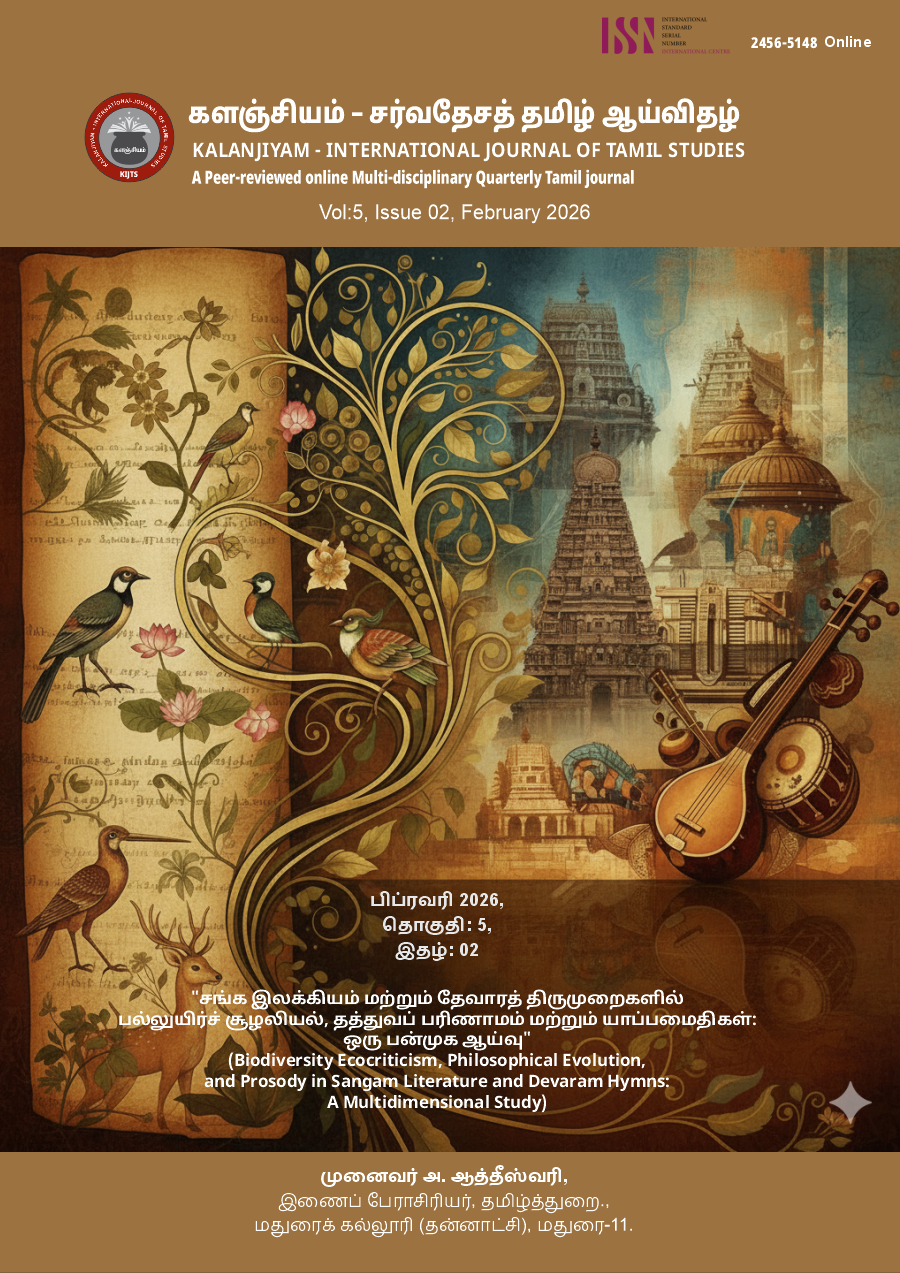
In the history of Tamil literature, the Bhakti Movement is regarded as a monumental social, religious, and literary renaissance. Specifically, within the Panniru Thirumurai—the foundational texts of Saivism—the first seven volumes, known as the Devaram, represent a pinnacle of both poetic and philosophical excellence. These hymns, graced by the Moovar Mudhaligal (St. Thirugnanasambandar, St. Thirunavukkarasar, and St. Sundaramurthi Swamigal), do not merely approach the Almighty as an abstract philosophical entity but perceive Him as the very essence of nature and the foundation of the universe.
This research paper deeply analyzes how the natural descriptions recurring in the Devaram hymns illustrate the attributes of the Param-porul (Supreme Being). It explains in detail how the Saiva Thirumurais internalize the 'Ullurai Uvamam' (implied metaphor) technique inherited from Sangam literary tradition, transforming natural elements into symbols that explain spiritual truths.
The study focuses on the beauty of the Lord’s form, the philosophical symbolism of His ornaments, the experience of Sivanubhava expressed through the actions of animals and birds, and the ritualistic significance of flowers. Furthermore, it describes—with supporting data—how the three core truths of Saiva Siddhanta (Pathi - God, Pasu - Soul, and Paasam - Bondage) are interwoven into descriptions of nature, and how these hymns were systematized during the Chola period to become a definitive social identity.
References
9 references- [1.] Atheeswari, A., and G. Ragu. "Varunanaiyin Nilaippattiyalil Paramporul." Kalanjiyam, Madura College, Madurai. (Original Document).
- [2.] Champakalakshmi, R. "Religious Conflict in the Tamil Country: A Re-appraisal of Epigraphic Evidence." Journal of the Epigraphical Society of India, vol. 5, 1978, pp. 69-83.
- [3.] Chevillard, Jean-Luc. "Digital Tevaram Project." Linguist Univ-Paris, 1996.
- [4.] Devasenapathi, V. A. Saiva Siddhanta: As Expounded in the Sivajnana-Siddhiyar and its Six Commentaries. University of Madras, 1974.
- [5.] Dorai Rangaswamy, M. A. The Religion and Philosophy of Tevaram. University of Madras, 1990.
- [6.] Mahadevan, S. "Devarathil Iyarkai Varunanaigal Matrum Tattuva Pinnani." Katurai Tamil Blog, 2013.
- [7.] Peterson, Indira Viswanathan. Poems to Siva: The Hymns of the Tamil Saints. Princeton UP, 1989.
- [8.] "The Impact of Paadaan Thinai in Moovar Thevaram." Tamilmanam International Research Journal of Tamil Studies, vol. 7, no. 1, 2026, pp. 172-185.
- [9.] Zvelebil, Kamil. A History of Indian Literature: Tamil Literature. Otto Harrassowitz, 1974.
How to Cite