
Journal title (In Regional) களஞ்சியம் - சர்வதேச தமிழ் ஆய்வு இதழ்
Journal title (In English) KALANJIYAM – International Journal of Tamil Studies
Publication language Tamil (தமிழ்), English, Abstract and References in English
Abbreviated key-title: KALANJIYAM - KIJTS
Publishing frequency Quarterly (February, May, August, and November)
E-ISSN 2456-5148
DOI registered Tamil Journal
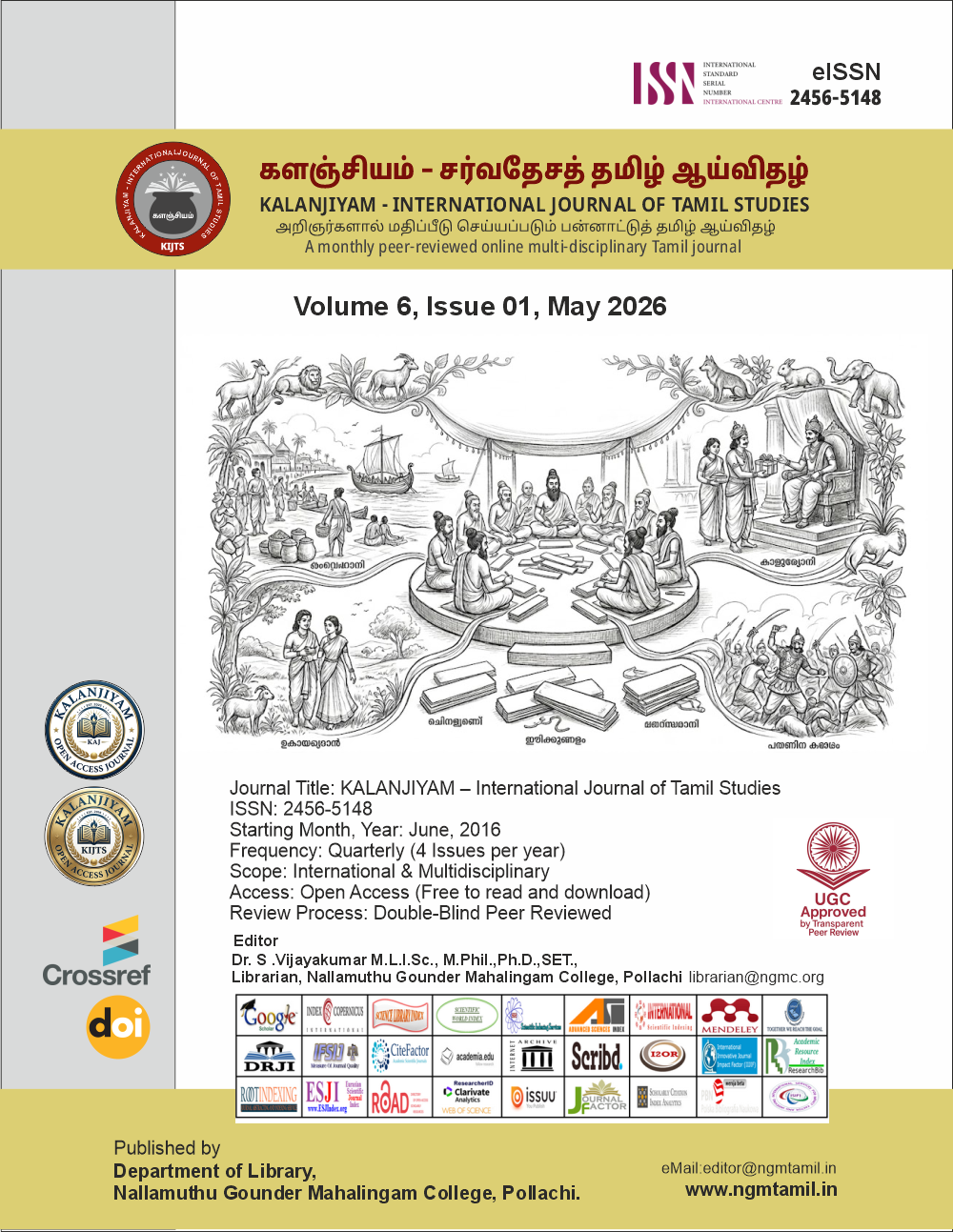
Vol. 6 No. 01 (2026): Kalanjiyam May 2026
Articles
-
அழிந்து வரும் சிற்றலை வானொலிகள்: வரலாறு, வீழ்ச்சி மற்றும் எதிர்காலப் பார்வை The Vanishing Shortwave Radios: History, Decline, and Future Outlook
N. Arun Kumar IndiaShortwave radio has historically served as a vital pillar of global communication, utilizing high-frequency signals to bridge vast distances and connect the global Tamil diaspora to their linguistic roots. Beyond mere information sharing, these broadcasts fostered a unique sense of cultural belonging and provided a platform for language preservation during eras when digital connectivity was non-existent. This research paper meticulously examines the historical trajectory of Tamil shortwave services, analyzing their profound socio-cultural influence and the subsequent decline triggered by the rise of satellite technology and internet streaming. Furthermore, the study evaluates the contemporary challenges of high operational costs against the potential for a digital resurgence through Digital Radio Mondiale (DRM), ultimately assessing the medium's enduring relevance as a resilient communication tool in an increasingly digital-centric world.
Pages: 1-9Views: 0 Downloads: 00 0இந்திய - சைகை மொழி: உலகத்தரமும் பண்பாட்டு ஆழமும் கொண்ட இயற்கையான, முழுமையான மொழி Indian Sign Language: A Natural, Complete Language of Global Standards and Cultural Depth
Dr. P. Jayachandran Assistant Professor (SG), Saveetha School of Education and Research (SPIER), Saveetha Institute of Medical and Technical Sciences (SIMATS) IndiaThis research paper explores Indian Sign Language (ISL) as a linguistically complete, culturally rooted, and socially significant natural language. Used by millions of Deaf individuals across South Asia, ISL possesses all the structural grammatical components of a human language: a formal phonology, productive morphology, rule-governed syntax, and a vocabulary capable of expressing nuanced, technical concepts.
This paper argues that ISL is not merely a tool for communication but a "Great Language" based on its complexity, its ability to adapt to India's diverse cultural contexts, and its growing institutional recognition. The study examines the grammatical structure of ISL, its historical origins, dialectal variations, relationships with other sign languages, and current legal and educational frameworks.
While recognition under the Eighth Schedule of the Constitution is still pending, the Rights of Persons with Disabilities Act (2016) and the National Education Policy (2020) have created unprecedented opportunities for the growth of ISL. The paper concludes that ISL, as one of India's most vital linguistic treasures, deserves full official recognition.
Pages: 10-22Views: 0 Downloads: 00 0Dr. P. Jayachandran (1)- (1) Assistant Professor (SG), Saveetha School of Education and Research (SPIER), Saveetha Institute of Medical and Technical Sciences (SIMATS), India
10-22பாலகுமாரன் புதினங்களில் குடும்ப உறவுகள் Family Relationships in the Novels of Balakumaran
S.Tirupathi Part-time Doctoral Research Scholar, Department of Tamil, Ganesar College of Arts and Science (Affiliated with Bharathidasan University), Melaisivapuri - 622407. India , Dr. M. Selvarasu Research Guide, Associate Professor & Research Advisor (Retd.), Department of Tamil, Ganesar College of Arts and Science (Affiliated with Bharathidasan University), Melaisivapuri - 622407. IndiaBalakumaran is a significant writer in the landscape of the Tamil novel. His works are deeply rooted in both family and society. In particular, his novels provide extensive space for exploring family relationships. By centering his narratives on middle-class individuals and those leading ordinary lives, his novels offer a profound understanding of the family as an institution.
Balakumaran illustrates through various life situations how human relationships and conflicts serve as the driving forces behind social dynamics. The novelist captures diverse mindsets where the perception of life varies for every individual and presents them as compelling fiction. Ultimately, he records the indispensability of the family for the continuous progression of human life through a simplified lens in his creative works.
Pages: 23-29Views: 0 Downloads: 00 0S.Tirupathi (1), Dr. M. Selvarasu (2)- (1) Part-time Doctoral Research Scholar, Department of Tamil, Ganesar College of Arts and Science (Affiliated with Bharathidasan University), Melaisivapuri - 622407., India
- (2) Research Guide, Associate Professor & Research Advisor (Retd.), Department of Tamil, Ganesar College of Arts and Science (Affiliated with Bharathidasan University), Melaisivapuri - 622407., India
23-29இதழியல் வரலாற்றில் புதியதலைமுறை Puthiya Thalaimurai in the History of Journalism
Dr.G.Elizabethrani Assistant Professor in Tamil, Holy Cross College (Autonomous), Tiruchirappalli-620 002 IndiaCountless events are happening across the globe every single minute. Journalism is the art of capturing these events and presenting them to the world. Even in an era where computerized communication devices dominate information exchange, the contribution of journals and magazines remains uniquely significant. The role of journalism in social development, manifested in written and printed forms, serves as a vital record for the future.
Journals are capable of performing various general and specialized functions. Among the many publications that serve as archives of news collection, Puthiya Thalaimurai magazine holds a noteworthy and distinct place. This article discusses how Puthiya Thalaimurai magazines present essential ideas with social awareness, demonstrating a deep-seated concern for the younger generation.
Pages: 30-41Views: 0 Downloads: 00 0Dr.G.Elizabethrani (1)- (1) Assistant Professor in Tamil, Holy Cross College (Autonomous), Tiruchirappalli-620 002 , India
30-41இடம் பெயர்ந்தவர்களின் பண்பாட்டுச் சூழல் The cultural environment of the migrants
Dr. S. Palpandi Assistant Professor, Dept. of Tamil, Faculty of Science & Humanities, SRMIST, VadapalnI , Channai IndiaIn the research-intensive approach presented to the world by Tamil scholars of history; Economics as the primary example; Migration is the primary focus of human social life engaged in industry. The continuation of the bureaucratic conflict between the primary locational society and the migration society, as well as the religious conflict, is found in historical records (embedded). The study is guided by the fact that language and religion continued to be a subsidiary factor in stabilizing the power of the people who moved to a new place.
இடம் விட்டு இடம் நகருதல் கால ஓட்டத்தில் தன்னிலைப் படுத்திக்கொள்ளும் மானிட இனக்குழுச் சமூகத்தின் வாழ்வியல் நெறியே. மானுடம் முதலில் உணவிற்கு நகர்ந்து இருப்பிடத்தையும் பண்பாட்டு நெறியையும் வகுத்திருப்பதை திணை வாழ்வான நிலமும் உரிப்பொருளும் தக்கச் சான்றுடன் விளம்புகிறது. பின்னர், மொழி வளமான நாகரிகப் பண்பாட்டை நிலம் சார்ந்த இனக்குழு தகவமைத்ததை செவ்விலக்கியங்கள் வரையறை செய்கின்றன எனலாம். மானுடச் சமூகம் நாகரிகம் அடைந்த பன்னூற்றாண்டின் பின்னர் வாழ்வின் சூழமைவு எதிர்கொண்ட சமூகம் புலம் பெயர்வு என்னும் இடப்பெயர்வை காலம்தோறும் தகவமைப்பதை மொழி, மதம், பொருள் என விரிந்த நோக்கத்துடன் ஆய்வு அமைந்துள்ளதை விளம்புகிறது.
Pages: 42-50Views: 0 Downloads: 00 0Dr. S. Palpandi (1)- (1) Assistant Professor, Dept. of Tamil, Faculty of Science & Humanities, SRMIST, VadapalnI , Channai, India
42-50முழுமையான ஆரோக்கியம் மற்றும் நல்வாழ்விற்காக ஆயுர்வேதம் மற்றும் யோகாவை ஒருங்கிணைத்தல்: ஒரு விரிவான ஆய்வு Integrating Ayurveda and Yoga for Holistic Health and Well-being
Dr S Jagadambal Assistant Professor, Department Of Human Excellence, Nallamuthu Goundar Mahalingam College, Pollachi. IndiaYoga and Ayurveda are two interrelated branches of Vedic knowledge that together offer a comprehensive approach to holistic health and well-being. While Ayurveda primarily focuses on the maintenance of physical health through diet, lifestyle, and herbal interventions, Yoga emphasizes mental, emotional, and spiritual development. Despite their distinct roles, both systems share common philosophical foundations and often overlap in their approaches to health promotion and disease prevention. This paper explores the integrative framework of Yoga and Ayurveda, highlighting their complementary functions within the Vedic system. It also examines how their combined application can enhance overall well-being by addressing the body, mind, and consciousness. The study underscores the relevance of this integrative approach in modern healthcare for promoting sustainable health and self-realization.
Ayurveda, one of the four Upavedas—alongside Gandharva Veda, Sthapatya Veda, and Dhanur Veda—represents the application of Vedic knowledge to the science of life and holistic healing. Rooted in the ancient Vedic tradition, it is closely aligned with Yoga, both emerging from the same philosophical foundation aimed at understanding the nature of the universe and human consciousness. Vedic knowledge, described as a mantric science developed by seers and yogis, provides insights into the inner workings of existence and guides individuals toward self-realization and liberation. Within this framework, Ayurveda focuses on maintaining physical health through balanced living, while Yoga emphasizes mental, emotional, and spiritual well-being. Together, they form a complementary and integrative system that addresses all dimensions of human life. This paper explores the interconnected roles of Ayurveda and Yoga within the Vedic system and highlights their relevance in promoting holistic health and well-being in contemporary society..
Pages: 51-59Views: 0 Downloads: 00 0Dr S Jagadambal (1)- (1) Assistant Professor, Department Of Human Excellence, Nallamuthu Goundar Mahalingam College, Pollachi., India
51-59நம்மாழ்வார் காட்டும் இராமாவதாரக் கொள்கைகள் The Principles of Rama's Incarnation as Depicted by Nammalvar
R. Priya Ph.D. Research Scholar, Thiagarajar College, Madurai 09. India , Dr. S. Ganthidurai Research Guide and Head of the Department of Tamil, Thiagarajar College, Madurai 09. IndiaNammalvar, revered by Vaishnavites as the Kulapati (head of the lineage) and the Prathama Acharya (the first teacher), possessed an immense devotion to Lord Rama. He was so distinguished in his piety that he is often regarded as a reincarnation of Rama himself. This article provides a detailed exploration of how Nammalvar’s hymns elegantly illustrate the principles and attributes of Sri Rama—highlighting his prowess as a warrior, his virtuous character, his compassionate heart, his unwavering commitment to truth, and his profound respect for his parents.
வைணவா்களால் குலபதி என்றும் பிரதம ஆச்சாரியார் என்றும் போற்றப்படுபவர் நம்மாழ்வார் இராமபிரான் மீது பெரும் பற்றுக் கொண்டவர். இராமனின் மறுஅவதாரம் என்றழைக்கும் வகையில் சிறந்தவர். இராமன் எத்தகைய வீரன் குணநலன் மிக்கவன், கருணையுள்ளம் கொண்டவன், சத்தியம் தவறாதவன். தந்தை, தாயை மதிப்பவன் என்ற எண்ணற்ற குணநலன்களை தன்னகத்தே கொண்ட ஸ்ரீ இராமபிரானின் கொள்கைகளை நயம்பட எடுத்துக்கூறி நம்மாழ்வார் பாடியுள்ள திறத்தினை இக்கட்டுரையின் வழியே விளக்கமாக காணலாம்.
Pages: 60-65Views: 0 Downloads: 00 0R. Priya (1), Dr. S. Ganthidurai (2)- (1) Ph.D. Research Scholar, Thiagarajar College, Madurai 09., India
- (2) Research Guide and Head of the Department of Tamil, Thiagarajar College, Madurai 09., India
60-65எஸ். அர்ஷியாவின் புதினங்களில் நடப்பியல் அரசியல் Realist Political Discourse in the Novels of S. Arshiya
Saravanan K Ph.D Research Scholar (Part - time), Department of Tamil, N.G.M. College, Pollachi. India , Dr.Parameshwari T Associate Professor & Head, Department of Tamil (SF), N.G.M. College, Pollachi. IndiaThis study explores the nature of realist political discourse in the novel Sottangal by S. Arshiya. It critically investigates the tension between democratic ideals and lived political practices, with particular attention to party-centered propaganda, uncritical leader worship, ideological inconsistency, caste- and religion-based mobilization, politically sanctioned violence, and institutional compromise within law enforcement and the judiciary. Adopting a qualitative, text-oriented analytical framework, the study approaches these novels as interpretive representations of socio-political realities rather than as empirical historical accounts. The analysis demonstrates that democratic participation is frequently transformed into performative spectacle, while the preservation of power becomes the dominant organizing principle of political conduct. By engaging both realist and existential perspectives, these novels emerge as significant literary sites that document and critique contemporary political culture in Tamil Nadu.
Pages: 66-71Views: 0 Downloads: 00 0Saravanan K (1), Dr.Parameshwari T (2)- (1) Ph.D Research Scholar (Part - time), Department of Tamil, N.G.M. College, Pollachi. , India
- (2) Associate Professor & Head, Department of Tamil (SF), N.G.M. College, Pollachi. , India
66-71எஸ். ராமகிருஷ்ணன் நாவல்களில் சிறுதெய்வ வழிபாட்டு மரபுகள்: ஓர் ஆழ்நிலை ஆய்வு Minor Deity Worship Traditions in the Novels of S. Ramakrishnan: An In-depth Study
Santhanalakshmi G Part-Time Research scholar, Department of Tamil, Bishop Heber College (Autonomous A++), Affiliated to Bharathidasan University, Trichy, Tamilnadu, India. India , Dr J. Aruna Research Guide, Assistant professor, Department of Tamil, Bishop Heber College (Autonomous A++), Affiliated to Bharathidasan University, Trichy, Tamilnadu, India. India“Do not reside in a village that lacks a temple” is a proverb deeply ingrained in Tamil tradition. People hold a profound belief, viewing all the auspicious events in their lives as divine grace and their hardships or ill-effects as divine wrath. This faith emerged during the dawn of human civilization from a primal fear of nature; it later evolved into nature worship and, over time, progressed into the worship of minor and major deities. Among rural folk, the worship of minor deities is intricately interwoven with their culture, history, and social structure.
In the landscape of modern Tamil literature, S. Ramakrishnan—a leading contemporary writer—meticulously records the soil, the people, and the beliefs of the Karisal (black soil) region in his novels. This paper analyzes the methods of minor deity worship, rituals, beliefs, and their social backgrounds as depicted in S. Ramakrishnan’s novels Thuyil, Sancharam, and Nimitham. Various dimensions, such as clan deities (Kuladeivam), guardian deities, goddess worship, and beliefs in malevolent spirits, are explored in detail through this study. Furthermore, this research establishes how folk deities serve as "Crisis Deities" for the people and how the author reveals social truths through literary fiction..
Pages: 72-81Views: 0 Downloads: 00 0Santhanalakshmi G (1), Dr J. Aruna (2)- (1) Part-Time Research scholar, Department of Tamil, Bishop Heber College (Autonomous A++), Affiliated to Bharathidasan University, Trichy, Tamilnadu, India.
- (2) Research Guide, Assistant professor, Department of Tamil, Bishop Heber College (Autonomous A++), Affiliated to Bharathidasan University, Trichy, Tamilnadu, India.
72-81புறநானூறு கூறும் பாரியின் வண்மை The Generosity of Pari as Portrayed in Purananuru
J. Dhanalakshmi Part-time Ph.D. Research Scholar, Department of Languages (Tamil), Karpagam Academy of Higher Education, Coimbatore. India , Dr. R. Aarthi Research Guide, Department of Languages (Tamil), Karpagam Academy of Higher Education, Coimbatore. IndiaThousands of species are born and live on this earth. Humans have categorized them from one-sensed to six-sensed beings. Every living creature possesses a unique trait. Similarly, humans are distinguished from other species by qualities such as love, character, charity, valor, passion, anger, jealousy, pride, and the drive to help others.
The world honors and praises those who internalize more than one of these noble virtues. Pari is one such sublime patron praised by the world. Much of literature speaks of Pari's character; this article aims to analyze those traits through the lens of Purananuru.
Pages: 82-88Views: 0 Downloads: 00 0J. Dhanalakshmi (1), Dr. R. Aarthi (2)- (1) Part-time Ph.D. Research Scholar, Department of Languages (Tamil), Karpagam Academy of Higher Education, Coimbatore., India
- (2) Research Guide, Department of Languages (Tamil), Karpagam Academy of Higher Education, Coimbatore., India
82-88திருஞானசம்பந்தர் தேவாரப் பாடல்களில் இயற்கையும் சூழலியலும்: ஒரு விரிவான ஆய்வுக் கட்டுரை Thirugnanasambandar’s Devaram Hymns – Nature and Ecology: A Comprehensive Research Article
Ku. Chithradevi Assistant Professor Department of Languages - Tamil Division Karpagam Academy of Higher Education Coimbatore – 641021 IndiaIt can be said that in the history of Tamil literature, there isn’t a single poet who has not sung about nature. From Sangam literature to contemporary modern poetry, nature has continuously remained an inseparable element of human life.
Specifically, during the era of devotional (Bhakti) literature, worshipping nature and perceiving the Divine within the beauty of the natural world were primary paths toward spiritual realization. The hymns of Thirugnanasambandar, who brought about a religious renaissance in Tamil Nadu during the 7th century, are richly infused with both deep devotional sentiment and profound ecological values.
Pages: 89-99Views: 0 Downloads: 00 0Ku. Chithradevi (1)- (1) Assistant Professor Department of Languages - Tamil Division Karpagam Academy of Higher Education Coimbatore – 641021, India
89-99தியாகி களப்பால் குப்புவின் சமுதாயப் பிரச்சனைகள்: தஞ்சை மண்டலப் பண்ணையடிமை முறை மற்றும் நிலவுடைமைச் சமூகக் கட்டமைப்பின் மீதான ஓர் விரிவான ஆய்வு The Social Issues of Martyr Kalappal Kuppu: A Comprehensive Study on the Serfdom System and Landownership Social Structure of the Tanjore Region
C. Sathya Sundari Part-time PhD Research Scholar Postgraduate and Tamil Research Department Khadir Mohideen College (Affiliated with Bharathidasan University) Adirampattinam, Tamil Nadu, India India , Dr. Khalil Rahman Research Guide, Associate Professor & Vice President Postgraduate and Tamil Research Department Khadir Mohideen College (Affiliated with Bharathidasan University) Adirampattinam, Tamil Nadu, India IndiaUsing Vaimainathan’s historical novel "Thyagi Kalappal Kuppu" as its primary source, this article provides a detailed analysis of the serfdom system (pannaiyadimai), caste structures, economic exploitation, and the rise of communist movements against these systems during the early and mid-20th century in the integrated Tanjore district.
The study explores the various dimensions of the tears, poverty, untouchability, and slavery of the working class hidden behind the fertility of the Tanjore soil. It explains how the life of Martyr Kalappal Kuppu served as a symbol for social change. Furthermore, the article discusses the food shortages caused by World War II, the class struggle between Mirasadars (landlords) and serfs, and the historical background leading to the enactment of the Tanjore Tenants and Pannaiyal Protection Act of 1952, incorporating other historical evidence.
Pages: 100-108Views: 0 Downloads: 00 0C. Sathya Sundari (1), Dr. Khalil Rahman (2)- (1) Part-time PhD Research Scholar Postgraduate and Tamil Research Department Khadir Mohideen College (Affiliated with Bharathidasan University) Adirampattinam, Tamil Nadu, India
- (2) Research Guide, Associate Professor & Vice President Postgraduate and Tamil Research Department Khadir Mohideen College (Affiliated with Bharathidasan University) Adirampattinam, Tamil Nadu, India
100-108பாரதி பாரதிதாசனின் தமிழ் உணர்வு Tamil Consciousness of Bharati and Bharathidasan
Dr. R. Gandhimathi Assistant Professor, Department of Tamil, Mazharul Uloom College (Autonomous), Ambur - 635802. IndiaAmong the twentieth century poets, Subramania Bharati and Bharathidasan are regarded as important poets who deeply expressed Tamil consciousness in their poems. Both poets considered the Tamil language as life, mother, and sweet nectar, and revealed their intense love for Tamil through their literary works. This article examines their deep attachment towards Tamil, Tamils, and Tamil Nadu, and their desire to spread the greatness of the Tamil language throughout the world.
The study explains how Bharati and Bharathidasan praised Tamil as Tamil Mother, life-breath, delight, and social responsibility. Bharati emphasized that Tamil should spread across the world and insisted on various efforts needed for the growth of the language. Bharathidasan glorified Tamil as life, nectar, honey, mother, and light, and expressed an inseparable relationship between himself and Tamil.
Further, the article comparatively analyses the Tamil consciousness, love for Tamil, concept of Tamil Mother, sweetness of Tamil, and Tamil service reflected in the poems of both poets. The study concludes that both poets valued Tamil above their own lives and dedicated their entire lives and activities to the growth and glory of the Tamil language.
Pages: 109-122Views: 0 Downloads: 00 0Dr. R. Gandhimathi (1)- (1) Assistant Professor, Department of Tamil, Mazharul Uloom College (Autonomous), Ambur - 635802., India
109-122திருமந்திரத்தில் வாழும் கலை Thirumanthirathil Valum Kalai
Dr. P. Ganeshvadivel Assistant Professor – Department of Tamil, Srimad Andavan Arts and Science College (Autonomous), (Affiliated to Bharathidasan University), Thiruvanaikoil, Trichy - 620005. IndiaAlthough modern humanity masters numerous arts and sciences to navigate the external world, we often neglect the essential spiritual "mantras" required to navigate life itself without suffering. The Thirumandiram serves as a profound guide to this existential alchemy, revealing the subtle life secrets (vazhviyal sutchamam) that link moral discipline to physical longevity. By daily cultivating the eradication of excessive desire, practicing absolute truthfulness, maintaining ethical conduct, and mastering the five senses, an individual aligns their internal energy with cosmic principles. Thirumoolar’s wisdom emphasizes that such a disciplined lifestyle is not merely a moral choice but a biological necessity; it ensures that both the mind and body remain resilient, free from disease, and sustained in a state of holistic well-being for a long and meaningful life.
Pages: 123-134Views: 0 Downloads: 00 0Dr. P. Ganeshvadivel (1)- (1) Assistant Professor – Department of Tamil, Srimad Andavan Arts and Science College (Autonomous), (Affiliated to Bharathidasan University), Thiruvanaikoil, Trichy - 620005., India
123-134திருக்குறளில் தகவல் தொழில்நுட்பச் சிந்தனைகள் Information Technology Thoughts in Thirukkural
Dr. M. Chennappan, M.A., M.Phil., D.T.Ed., Ph.D., SET. Assistant Professor, Department of Tamil, Don Bosco College – Dharmapuri. IndiaToday's world is moving towards the pinnacle of Information Technology (IT) development. The internet, artificial intelligence, databases, social media, e-governance, and online education have completely transformed human life. Although information technology offers various conveniences to human society, it has also brought challenges such as data insecurity, moral degradation, privacy violations, the spread of fake news, and cybercrimes.
In this context, the Thirukkural—which emerged two thousand years ago—not only provides ethical guidance for human life but also offers profound insights relevant to the modern information technology world.
This study comprehensively analyzes the concepts of Thirukkural in fields such as communication, data security, internet ethics, leadership, artificial intelligence, time management, social media usage, and educational technology. Furthermore, it emphasizes the necessity of humanity and ethics in the technological world.
Pages: 135-141Views: 0 Downloads: 00 0Dr. M. Chennappan, M.A., M.Phil., D.T.Ed., Ph.D., SET. (1)- (1) Assistant Professor, Department of Tamil, Don Bosco College – Dharmapuri., India
135-141Literary Representation of Barter Economy in Sangam Society
Prof. D. Uma Devi Professor of Tamil, Department of Indian Languages & Literary Studies, University of Delhi, New Delhi-110007 IndiaThis study examines the literary representation of the barter economy in Sangam society, drawing on evidence from the all eighteen texts of Sangam literature (Ettuthogai and Pattuppattu). Sangam literature serves as a vital source for reconstructing the socio-economic life of early Tamil communities. The concept of Paṇḍam (commodity) and Paṇḍa-Matrru (barter) reflects a structured system of exchange based on ownership, value, and reciprocity rather than a primitive Tamils mode of trade. The analysis highlights how goods such as elephant tusks, calves, paddy, salt, fish, meat, and toddy functioned as key commodities within this exchange network. Literary references reveal that barter transactions were often carried out across ecological regions Kuṟiñci, Mullai, Marutam, Neital and Palai indicating regional specialization and interdependence. Liquor shops and market streets emerge as important centres of exchange, while salt-producing areas also contributed to inland trade. Importantly, the study foregrounds the active participation of women in barter and trade, as evidenced by their roles in selling goods and facilitating exchanges across regions. The texts further demonstrate that commodities carried both economic and cultural significance, embodying social values and everyday practices. Additionally, the presence of equivalence and negotiated exchange suggests an early understanding of value systems and transactional fairness. By adopting an interdisciplinary approach, this study connects literary analysis with economic and anthropological perspectives to reconstruct the dynamics of the barter economy in Sangam society. It argues that Sangam literature not only documents economic practices but also encodes the cultural logic underlying exchange systems, thereby offering a comprehensive understanding of early Tamil socio-economic organization.
Pages: 142-151Views: 0 Downloads: 00 0Prof. D. Uma Devi (1)- (1) Professor of Tamil, Department of Indian Languages & Literary Studies, University of Delhi, New Delhi-110007
142-151மணிமேகலையில் சாங்கிய மெய்யியல் Sangya Philosophy in Manimegalai
Senbagam S Full-Time Research Scholar, Department of Tamil Studies, Government Arts College, Ariyalur - 621 713 (Affiliated to Bharathidasan University). India , Dr. Ilayaraja M Research Guide & Associate Professor, Department of Tamil Studies, Government Arts College, Ariyalur - 621 713 (Affiliated to Bharathidasan University). IndiaThe study examines how the Manimekalai Kappiyam records the Sangkiya philosophy prevalent in Tamil Nadu in the second century AD. Furthermore, it investigates how the text positions Samkhya (Sangkiya) in relation to the ascendant Buddhist philosophy championed by the epic's protagonist. By contrasting Kapila’s dualistic framework of Prakriti (matter) and Purusha (consciousness) against the Buddhist doctrines of dependent origination and impermanence, the study illuminates the vibrant intellectual debates of the Sangam and post-Sangam eras. Ultimately, this research underscores the Manimekalai not merely as a religious narrative, but as an invaluable historical compendium that preserves the nuances of early Indian philosophical systems as they were understood and debated in the ancient Tamil landscape.
Pages: 152-161Views: 0 Downloads: 00 0Senbagam S (1), Dr. Ilayaraja M (2)- (1) Full-Time Research Scholar, Department of Tamil Studies, Government Arts College, Ariyalur - 621 713 (Affiliated to Bharathidasan University)., India
- (2) Research Guide & Associate Professor, Department of Tamil Studies, Government Arts College, Ariyalur - 621 713 (Affiliated to Bharathidasan University)., India
152-161அறிவியக்க நோக்கில் சஞ்சீவி பர்வதத்தின் சாரல் An Intellectual Movement Perspective on 'Sanjeevi Parvathathin Saaral'
Dr.A.Karvannan Assistant Professor, Department Of Tamil, Agurchand Manmull Jain College, Meenambakkam, Chennai-600061. IndiaThe Tamils led a natural lifestyle deeply integrated with nature. However, Sanskrit Puranas and epic narratives exerted a significant impact on the self-respecting intellectual tradition of the highly civilized Tamil society. Consequently, Varnasrama concepts infiltrated the Tamil tradition, giving rise to caste and religious divisions. At the peak of this influence, superstitious practices became dominant, creating a thoughtless societal trend that led to a setback for Tamil society.
During the 18th and 19th centuries, influenced by Western art and literature, Tamil scholars rediscovered their rich heritage. They began opposing the Puranic and epic literatures responsible for these divisions and ventured into creating counter-rationalist literature. This resulted in a massive social revolution on Tamil soil.
Among those who laid the foundation for this social revolution, Pavendar Bharathidasan is highly prominent. His work ‘Sanjeevi Parvathathin Saaral’ (The Slopes of Sanjeevi Hills) can be considered a piece of literature that directly countered the epics and Puranas to create a powerful impact. This research article lucidly presents the concepts of equality, women's rights, rationalism, and universal humanism expounded in this short epic poetry with appropriate evidence.
Pages: 162-169Views: 0 Downloads: 00 0Dr.A.Karvannan (1)- (1) Assistant Professor, Department Of Tamil, Agurchand Manmull Jain College, Meenambakkam, Chennai-600061., India
162-169முருகனின் சொல்லாட்சி சிறப்புகள் The Rhetorical Excellences of Murugan
Dr. M. Chitrakala Assistant Professor, Department of Tamil, N.G.M. College, Pollachi. IndiaThis research paper, titled "The Rhetorical Excellences of Murugan," analyzes through literature the various names of Murugan, his divine grace bestowed upon the people, and the glory of Lord Murugan being worshiped and revered not only in Tamil Nadu but across the world. Although Murugan has more than a thousand and eight names, considering the scope of this study, only specific names have been analyzed: Murugan, Velan, Vetrivel, Arumugan, Karthikeyan, Asurar Kudigedutha Aiyan (the Lord who destroyed the clan of demons), Senthil, Kadamban, Subramanyan, Thagappan Swami, Skandan, and Dhandayudhapani. Notably, the study concludes with a summary and a bibliography of reference books.
Pages: 170-179Views: 0 Downloads: 00 0Dr. M. Chitrakala (1)- (1) Assistant Professor, Department of Tamil, N.G.M. College, Pollachi., India
170-179தொல்காப்பிய அகத்திணை நோக்கில் திருஞானசம்பந்தரின் அகப்பாட்டுப் பதிகங்கள் "Thirugnanasambandar's Akam (Interior/Love) Hymns from the Perspective of Tolkappiyam's Akattinai (The Poetics of Interior Love)"
Subala K. Research Scholar of Tamil, Reg.No. 23PHTMF002, Avinashilingam Institute for Home Science and Higher Education for Women, Coimbatore, TamilNadu - 641 043, India. India , Dr.Geetha.M Assistant Professor (SS), Department of Tamil, Avinashilingam Institute for Home Science and Higher Education for Women, Coimbatore, TamilNadu - 641 043, India IndiaIn the Tamil literary tradition, devotional hymns clearly demonstrate the deep connection between the akam (interior) tradition and Bhakti literature. The emotional themes, psychological states, and grammatical structures found in Sangam-era akam poetry reappear in later devotional works with a renewed spiritual meaning. In particular, the hymns of Thirugnanasambandar in the Tevaram reflect the akam poetic mode, where God is portrayed as the hero and the soul as the heroine. This article examines Thirugnanasambandar’s akam-based hymns through the grammatical principles outlined in the Tolkappiyam. It explores elements such as divine grace, love, longing, separation, lamentation, and ethical restraint as expressions of akam poetics within a spiritual framework. The deep devotion of the soul toward God is expressed in the language of love, with the ultimate aim of achieving union with the divine and experiencing supreme bliss. Furthermore, this study establishes that the akam conventions of the Tolkappiyam continue within Bhakti literature, creating a meaningful bridge between human emotions and spiritual experience. Titled “Akam Poetic Hymns of Thirugnanasambandar from the Perspective of Tolkappiyam”, the article is organized into sections including introduction, expression of divine grace, worship, divine vision in the Tirumurai, akam hymns in Tirukkadaikkappu, the “heart-stealing beloved,” the heroine’s loss of beauty, the messenger motif, ethical stance, lament of the heroine, expression of longing, description of the hero’s place, and akam poetics. The study concludes with a comprehensive conclusion synthesizing these ideas.
Pages: 180-193Views: 0 Downloads: 00 0Subala K. (1), Dr.Geetha.M (2)- (1) Research Scholar of Tamil, Reg.No. 23PHTMF002, Avinashilingam Institute for Home Science and Higher Education for Women, Coimbatore, TamilNadu - 641 043, India.
- (2) Assistant Professor (SS), Department of Tamil, Avinashilingam Institute for Home Science and Higher Education for Women, Coimbatore, TamilNadu - 641 043, India
180-193குமரி மாவட்ட கவிஞர்களின் கவிதைகளில் அடித்தள மக்களின் வாழ்வியல் The Lived Experiences of Subaltern Communities in the Poems of Kanyakumari District Poets
Dr.S.Elamaran Assistant Professor, Department of Tamil & Research Centre, Lekshmipuram College of Arts & Science, Neyyoor, Kanniyakumari-629 802. IndiaThe poems of the poets of Kanyakumari District reflect the lives of the marginalized communities: the Vannars (washerfolk) who earn their livelihood by washing soiled clothes; the Navithars (barbers) who make a living by grooming and cutting hair; and the goldsmiths, whose existence and economic stability have been severely affected by urbanization and technological advancements. They also portray the lives of people who survive by tapping rubber trees, climbing coconut and palmyra trees, and harvesting paddy in the forests, hill tracts, agricultural fields, and villages at the foothills of the mountains. Furthermore, these poems depict the hardships endured by women working in brick kilns and represent the lives of other subaltern and working-class communities.These poems serve as a bridge between the land and its lived culture. They record the cultural transformations experienced by both the poets of the soil and the people themselves. The poems of Kanyakumari District vividly portray the struggles of the marginalized people, whose lives are shaped by debts, hopes, customs, and rituals. The poems of Thanupichchaiya, N. Sivakumar, T. Regith Kumar, and Benjamin not only powerfully articulate the cultural voice of the soil but also bring to light several cultural elements that have hitherto remained outside the mainstream and have not received central attention.
Pages: 194-200Views: 0 Downloads: 00 0Dr.S.Elamaran (1)- (1) Assistant Professor, Department of Tamil & Research Centre, Lekshmipuram College of Arts & Science, Neyyoor, Kanniyakumari-629 802., India
194-200கம்பரின்அனுமன் Kamban’s Hanuman
Maheswariveerappan Part-time Ph.D. Research Scholar, Ref.No.16781/Ph.D.K8/Tamil/Part Time, Department of Tamil, Ganesar College of Arts and Science, Melasivapuri. India , Dr. Peri. Azhagammai Research Guide, Assistant Professor, Department of Tamil, Ganesar College of Arts and Science, Melasivapuri IndiaThe Kambaramayanam holds a place of pride, adorning the forefront of unparalleled literary works in Tamil. It is magnificent, brimming with both literary excellence and devotional fervor. A unique distinction of Kamban lies in how he integrates diverse characters throughout the epic to enhance its grandeur. He provides them with situations and actions tailored to their nature and merit, revealing their character traits through both the poet's own narrative and the dialogue of other characters. In this regard, this article is structured to describe Hanuman, who stands out as a supreme creation in character portrayal. Beyond his celebrated role as the quintessential emissary, Hanuman is depicted by Kamban as a flawless blend of intellectual brilliance, linguistic mastery, and unwavering humility. This study meticulously analyzes the critical episodes where Hanuman's astute diplomacy and moral fortitude shift the trajectory of the epic. By examining the subtle nuances in his dialogues and actions, the article explores how Kamban elevates Hanuman from a loyal warrior to an embodiment of divine wisdom. Ultimately, this research highlights how the characterization of Hanuman serves as a foundational pillar for the epic's overarching spiritual and ethical narrative.
Pages: 201-213Views: 0 Downloads: 00 0Maheswariveerappan (1), Dr. Peri. Azhagammai (2)- (1) Part-time Ph.D. Research Scholar, Ref.No.16781/Ph.D.K8/Tamil/Part Time, Department of Tamil, Ganesar College of Arts and Science, Melasivapuri., India
- (2) Research Guide, Assistant Professor, Department of Tamil, Ganesar College of Arts and Science, Melasivapuri, India
201-213தொல்காப்பியம் உணா்த்தும் இல்லறவொழுக்கம் Domestic Life Virtues Expounded in Tolkappiyam
Dr. R. Vanithamani Assistant Professor, Department of Tamil, Queen's College of Arts and Science for Women, Affiliated to Bharathidasan University, Punalkulam, Pudukkottai. IndiaJust as a mother is profoundly important to every individual, the mother tongue is equally cherished with utmost significance. In this regard, Tolkappiyam is the most ancient among the grammatical texts available to us in Tamil today. While all world languages have formulated their own grammars, Tolkappiyam brings unparalleled prestige to the Tamil language. It is a classical, ancient text that elucidates the culture of the Tamil language, the antiquity of Tamil literature, and the excellence of its civilization.
Generally, in the present era where readers who appreciate grammatical texts are becoming scarce, the reason many still seek out Tolkappiyam is that, although it is a great grammatical treatise, it does not stop at prescribing rules merely for letters (orthography) and words (morphology). Rather, it also establishes the grammar for literature rooted in the lifestyle of the Tamils. Beyond formulating a comprehensive grammar for the entirety of the Tamil language, Tolkappiyam also reveals the Agam (inner life/love) and Puram (outer life/valor and society) of the people of its time. Tolkappiyar naturally and authentically documented the exact lives of his contemporaries within his grammatical framework. Furthermore, he beautifully captured their lifestyles, presenting them as a picturesque grammatical masterpiece. Moreover, a country's inscriptions, copper plates, architectural structures, coins, and its ancient literature serve as vital tools to understand the ancient history, lifestyle, and civilization of its people. Born from the ancient clan that "originated even before stones and soil appeared," the literary treasure for discovering the history of the Tamils is Tolkappiyam—a foundational text that shines as an eternal guiding lamp for our classical Tamil language. The rare Tamil elements found within it serve as essential aids in articulating the magnificent civilizational history of the people. Accordingly, the primary objective of this research is to analyze the domestic virtues (Illaravolukkam) as indicated in Tolkappiyam.
Pages: 214-231Views: 0 Downloads: 00 0Dr. R. Vanithamani (1)- (1) Assistant Professor, Department of Tamil, Queen's College of Arts and Science for Women, Affiliated to Bharathidasan University, Punalkulam, Pudukkottai., India
214-231ஆசாரக்கோவையில் இல்லறப் பண்புகள் Domestic Virtues in Aasarakkovai
Dr. R. Vanitha Bharathidasan University IndiaAasarakkovai is a noteworthy text among the literatures that emerged to nurture human dignity. It was created on the foundational principle that moral values and discipline must endure in every aspect of life. The Pathinenkeelkanakku (Eighteen Lesser Texts) books are classified based on the concepts of Aram (Virtue), Porul (Wealth), and Inbam (Love/Pleasure). Aasarakkovai highlights moral and disciplined virtues through Venba (a form of classical Tamil stanza) consisting of five or fewer lines. Specifically, this paper delves into how the text outlines the core responsibilities of a householder, emphasizing that a harmonious domestic life is built on clean habits, respect for elders, and unconditional hospitality. By analyzing these poetic verses, the study illustrates how daily routines and social etiquette are elevated into spiritual and moral duties. Ultimately, this research aims to highlight the enduring relevance of these ancient domestic ethics in guiding modern family structures toward a righteous path.
Pages: 232-240Views: 0 Downloads: 00 0Dr. R. Vanitha (1)- (1) Bharathidasan University, India
232-240கவிஞர் வாணிதாசனாரின் மொழி மற்றும் நாட்டுப்பற்றுச் சிந்தனைகள் Thoughts on Tamil Language and Patriotism in the Poetry of Vanidasan
Ms. M. Sivabakiya Ph.D. Scholar of Tamil (Reg. No. MKU24FFOL11462), Lady Doak College, Affiliated to Madurai Kamaraj University, Madurai, Tamil Nadu, India. India , Dr. A. Kamalam Associate Professor, Research Centre of Tamil, Lady Doak College, Affiliated to Madurai Kamaraj University, Madurai, Tamil Nadu, India. IndiaPoet Vanidasan extols the Tamil language as a life-giving force that animates the beauty reflected in painting, as well as an embodiment of the aesthetic elegance manifested in sculpture. He further equates Tamil with the valor deeply embedded in the hearts of warriors, thereby venerating Mother Tamil as a powerful and inspiring presence. The poet celebrates Tamil as a youthful and progressive feminine entity, proudly acknowledging her as the progenitor of eminent sages such as Thiruvalluvar and Ilangovadigal. Recognizing Tamil as one of the classical languages distinguished by its grammatical precision and literary richness, Vanidasan emphasizes the necessity of preserving it with the same care a mother extends to her child. He advocates safeguarding the language from external linguistic influences and promoting education through the medium of the mother tongue. This study seeks to examine the aesthetic pleasure derived from Tamil music, the cultural and historical pride associated with Tamil Nadu, and the deep-rooted sense of patriotism towards the motherland embedded within Tamil identity.
Pages: 241-250Views: 0 Downloads: 00 0Ms. M. Sivabakiya (1), Dr. A. Kamalam (2)- (1) Ph.D. Scholar of Tamil (Reg. No. MKU24FFOL11462), Lady Doak College, Affiliated to Madurai Kamaraj University, Madurai, Tamil Nadu, India.
- (2) Associate Professor, Research Centre of Tamil, Lady Doak College, Affiliated to Madurai Kamaraj University, Madurai, Tamil Nadu, India.
241-250காடர் பழங்குடிகள் Kadar Tribes
B. Anjali PhD Research Scholar, Department of Tamil, N.G.M. College, Pollachi. India , S. Jamuna Research Supervisor, Assistant Professor, Department of Tamil, N.G.M. College, Pollachi. IndiaWhen documenting the history of marginalized communities, traditional historical evidence is often scarce. This is because a group whose cultural identities have been stripped away or denied is unlikely to possess formal historical records. However, if a group or clan is dispersed across various locations within a specific territory, evidence unavailable in one area may be found in another. Furthermore, oral traditions preserve data regarding a community's antiquity, occupations, and culture. There is an intrinsic link between the history of a community and its folklore-which encompasses oral traditions and customs; in essence, folklore constitutes an integral part of a community's history. These elements are inextricably intertwined. Evidence of a community's socio-cultural history is found within its oral traditions, rituals, customs, and material culture. The objective of this study is to document and disseminate the cultural identity of the Kadar tribe as a historical record.
Pages: 251-258Views: 0 Downloads: 00 0B. Anjali (1), S. Jamuna (2)- (1) PhD Research Scholar, Department of Tamil, N.G.M. College, Pollachi., India
- (2) Research Supervisor, Assistant Professor, Department of Tamil, N.G.M. College, Pollachi., India
251-258உதயணகுமார காவியத்தில் இசைக்கலை The Art of Music in Uthayanakumara Kaviyam
K. Selvakamatchi PhD Research Scholar, Tamil Advanced Research Centre, Thiagarajar College, Madurai – 09 India , Dr. N. S.K. Sangeethradha Research Guide, Assistant Professor, Tamil Advanced Research Centre, Thiagarajar College, Madurai – 09 IndiaThe objective of this research paper is to analyze the information related to the art of music in Udayanakumara Kavyam. The central themes of this study include the indispensability of arts in human life, the Jain perspective on art, the social and cultural significance of music, and the practical application of music in daily life. This paper explains the importance given to arts in Jain literature, the classification of arts meant for men and women, and the cultural value of these arts.
In Udayanakumara Kavyam, the art of music is depicted as having the power to captivate not only humans but also animals, birds, celestial beings (Gandharvas), and other living creatures. Udayanan's musical skill brings about various turning points in his life. Events such as gaining freedom from imprisonment, earning the respect of kings, teaching music to Vasavadatta and Padmavati, and reclaiming the divine lute (Devayazh) demonstrate the power and social value of music. Furthermore, the epic emphasizes the necessity of preserving and passing down artistic traditions to the next generation by teaching arts from early childhood..
Pages: 259-267Views: 0 Downloads: 00 0K. Selvakamatchi (1), Dr. N. S.K. Sangeethradha (2)- (1) PhD Research Scholar, Tamil Advanced Research Centre, Thiagarajar College, Madurai – 09, India
- (2) Research Guide, Assistant Professor, Tamil Advanced Research Centre, Thiagarajar College, Madurai – 09, India
259-267திருக்குறளில் கல்வியுடைமை: ஓர் ஆய்வு An In-Depth Investigation into Education in Thirukkural
Dr. J. Krishna Kumari Assistant Professor of Tamil, Vel Tech Multi Tech. Dr. Rangarajan Dr. Sakunthala Engineering College, Avadi, Chennai - 600062 IndiaThis research paper presents an exhaustive study on the concept of 'Education' (Kalviudamai) as expounded in the Thirukkural, an ancient Tamil ethical masterpiece. The analysis categorizes education into four distinct dimensions: General Education, Vocational Education, Ethical Education, and Experiential Education. It explores the conceptual intersection between Thiruvalluvar's didactic principles and modern pedagogical theories, such as John Dewey’s Experiential Learning ("Learning by Doing") and Mahatma Gandhi’s vocational "Nai Talim" philosophy. Furthermore, this study integrates contemporary neuroscientific research to demonstrate how Valluvar's concept of flawless learning ("Karka Kasadara") aligns with high-order cognitive functions governed by the brain's Prefrontal Cortex, and memory consolidation mechanisms in the Hippocampus.4 Through this interdisciplinary approach, the paper establishes that ancient Tamil educational wisdom is not merely an ethical guide but a scientifically sound framework designed to cultivate holistic, ethically responsible, and socially conscious citizens.
Pages: 268-277Views: 0 Downloads: 00 0Dr. J. Krishna Kumari (1)- (1) Assistant Professor of Tamil, Vel Tech Multi Tech. Dr. Rangarajan Dr. Sakunthala Engineering College, Avadi, Chennai - 600062, India
268-277நற்றிணை: ஒளவையார் பாடல்களில் சொற்பொருண்மை செயற்பாடுகளும் மொழிநடைச் சிறப்பும் Natrinai: Semantic Functions and Stylistic Excellence in Avvaiyar’s Songs
K.Nalamaharajan (BDU2410632780623), Ph.D Research Scholar, Department of Tamil Studies, Bharathidasan University, Tiruchirappalli-620 024. India , Dr.M.Balakrishnan Associate Professor of Tamil, Centre for Distance and Online Education, Bharathidasan University, Tiruchirappalli-620 024. IndiaLanguage must adapt over time to survive; while many ancient languages have declined, Tamil has flourished continuously due to its inherent flexibility and adaptability. Even prior to antiquity, Tamil achieved remarkable linguistic and structural development, as evidenced by foundational grammatical works like the Tolkāppiyam and the refined compositions of Sangam literature. Today, Tamil studies expand across diverse fields, with linguistic and lexicographical research playing a vital role in analyzing the inseparable relationship between words, meanings, concepts, and references. Features such as synonymy and polysemy further enrich the language's expressive capability and functional scope. Integrating these semantic and linguistic elements, this research article provides a detailed examination of the songs composed by the poet Avvaiyar in the Natṟiṇai.
Pages: 278-294Views: 0 Downloads: 00 0K.Nalamaharajan (1), Dr.M.Balakrishnan (2)- (1) (BDU2410632780623), Ph.D Research Scholar, Department of Tamil Studies, Bharathidasan University, Tiruchirappalli-620 024., India
- (2) Associate Professor of Tamil, Centre for Distance and Online Education, Bharathidasan University, Tiruchirappalli-620 024., India
278-294தமிழ்க்கவிதைகள் பரிணாமப்பயணம் Tamil Poetry Literary Movements
G.Nirbankumar Part-time PhD Research Scholar Ganesar College of Arts and Science, Melaisivapuri-622 403, Pudukkottai District. (Affiliated with Bharathidasan University). India , Dr.V.A.Palaniappan Principal and Research Supervisor, Ganesar College of Arts and Science, Melaisivapuri (Affiliated with Bharathidasan University). IndiaIn the history of Tamil Literature, poetry is more than just a collection of words, it is a cultural identity of a society, a political tool, and a subtle expression of human emotions. With a continuous history spanning over two thousand years, the Tamil poetic tradition has undergone various transformations-from the grammatical rules of Yappu (prosody) in the era of Tolkappiyam to the liberated “New Poetry” (Pudukkavithai) of today. This research paper explores in detail how the Akavarpa and Kalippa traditions of Sangam Literature flourished, and the shifts brought about in poetic forms by medieval Bhakti literature and epics. Specifically, it deeply analyzes the revolution of prose-poetry (Vasana Kavithai) initiated by Bharathiyar in the 20th century, followed by the formal and thematic contributions made to modern poetry by literary movements such as Manikkodi, Ezhuthu and Vanambadi. Furthermore, it describes how Japanese poetic forms like Haiku, Senryu, and Tanka took root in the Tamil literary landscape and explains their technical structures. This study also examines how contemporary Tamil poetry aligns with global literary trends and provides a visionary perspective on future poetic forms.
Pages: 295-306Views: 0 Downloads: 00 0G.Nirbankumar (1), Dr.V.A.Palaniappan (2)- (1) Part-time PhD Research Scholar Ganesar College of Arts and Science, Melaisivapuri-622 403, Pudukkottai District. (Affiliated with Bharathidasan University)., India
- (2) Principal and Research Supervisor, Ganesar College of Arts and Science, Melaisivapuri (Affiliated with Bharathidasan University)., India
295-306எட்டுத்தொகை அக நூல்களில் "பெறுக" வியங்கோள் வினைமுற்று: உரையாசிரியர்கள் வழி பொருள்தரும் முறைகள் The Optative verb “Peruga” in the Ettuthokai love anthologies: Methods of interpretation by Commentators
Arun Selvakumar S Research Scholar, Reg. No. BDU2510632781443, Department of Tamil Studies, Bharathidhasan University, Tiruchirappalli – 620 024. India , Dr. N. Janakiraman Research Advisor, Associate Professor of Tamil, Centre for Distance and Online Education, Bharathidhasan University, Tiruchirappalli – 620 024. IndiaThe internal (akam) and external (puṟam) lives of ancient Tamil Scholars are intricately documented in the Sangam literary works, Eṭṭuthokai (The Eight Anthologies) and Pattuppāṭṭu (The Ten Songs). Among these, the interior-themed texts of Ettuthokai effectively convey the diverse emotional states of love and the perspectives of a variety of characters within established linguistic frameworks. Optative verbs (viyaṅkōḷ vinaimuttṟu) are frequently employed in Sangam literature to communicate the characters' four primary internal emotions and expressions: blessing (vāḻttal), scolding (vaital), requesting (vēṇḍutal), and commanding (vitittal). This research paper focuses on the specific optative verb "peruga" (may you receive/attain) as it is used in the core Ettuthokai love anthologies: Natrinai (natṟṟiṇai), Kurunthokai (kuṟuntokai), Aingurunooru (Aiṅkuṟunūṟu) and Akananooru (akanāṉūṟu). This study endeavors to examine the semantic shifts and unique contextual meanings of this word in relation to the changing landscapes (tiṇai) and the utterances of the characters, from both grammatical and literary perspectives.
Pages: 307-316Views: 0 Downloads: 00 0Arun Selvakumar S (1), Dr. N. Janakiraman (2)- (1) Research Scholar, Reg. No. BDU2510632781443, Department of Tamil Studies, Bharathidhasan University, Tiruchirappalli – 620 024., India
- (2) Research Advisor, Associate Professor of Tamil, Centre for Distance and Online Education, Bharathidhasan University, Tiruchirappalli – 620 024., India
307-316இலக்கியமும் சிறார் வாழ்வியல் Literature and Children's Life / Lifestyle
S. Arulsamy Ph.D. Research Scholar, Department of Folklore, Tamil University, Thanjavur – 10. India , Dr. Ilayaraja Supervisor / Research Guide, Assistant Professor, Department of Folklore, Tamil University, Thanjavur – 10. IndiaTamil literature boasts a deep historical background, with diverse literary genres evolving to meet the essential needs of society across different eras. These literatures serve as a medium to express human life experiences and inner emotions. Originating as unwritten oral traditions before being recorded on palm leaves, these genres have been heavily shaped by public preference, political landscapes, educational standards, foreign literary influences, and social transformations.
Among the profound experiences captured in literature, the blessing of children holds a paramount place. Children are viewed as a priceless treasure capable of making humans forget life's many sorrows; without them, even immense wealth and worldly status leave life feeling empty. Highlighting this indispensable value, the ancient poet-philosopher Thiruvalluvar remarked thousands of years ago in Thirukkural (Couplet 61) that there is no greater blessing in life than obtaining knowledgeable children. Ultimately, children represent an unmatched wealth defined by their innocent and pure nature.
Pages: 317-332Views: 0 Downloads: 00 0S. Arulsamy (1), Dr. Ilayaraja (2)- (1) Ph.D. Research Scholar, Department of Folklore, Tamil University, Thanjavur – 10., India
- (2) Supervisor / Research Guide, Assistant Professor, Department of Folklore, Tamil University, Thanjavur – 10., India
317-332பாரதி பாடல்களில் சித்தர் சிந்தனைகள்: ஓர் ஆழமான மெய்யியல் மற்றும் சமூகவியல் ஆய்வு Siddhar Thoughts in Bharati's Songs: An In-depth Philosophical and Sociological Study
Dr. R. Hemalatha Assistant Professor, Department of Tamil, B.S. Abdur Rahman Crescent Institute of Science and Technology, Vandalur, Chennai – 600 048 IndiaThe Siddhars expressed profound ideas such as humanism, equality, self-confidence, spirituality, love of nature, yoga, meditation, and wisdom in simple Tamil.1 These philosophical ideals have had a significant influence on the poetry of Mahakavi Subramania Bharati.1 Like the Siddhars, Bharati strongly opposed caste discrimination, superstition, and social injustice while emphasizing human equality and rational thinking.1 His poems, such as "Sādhigaḷ Illaiyadi Pāppā" ("There Are No Castes, Dear Child"), reflect the egalitarian principles of the Siddhar tradition.1 Furthermore, the continuity of Siddhar thought is evident in his emphasis on self-confidence, love of nature, humanism, spirituality, yogic discipline, and meditation.1 This study examines how the philosophical ideas of the Siddhar tradition are manifested in the poems of Mahakavi Bharati.1 The study concludes that Bharati was a poet who reinterpreted Siddhar philosophy in a form suited to the needs of modern society.1 His poetry stands as a rich literary legacy that promotes social transformation, human progress, and spiritual awakening.
Pages: 333-350Views: 0 Downloads: 00 0Dr. R. Hemalatha (1)- (1) Assistant Professor, Department of Tamil, B.S. Abdur Rahman Crescent Institute of Science and Technology, Vandalur, Chennai – 600 048, India
333-350தமிழ் இலக்கியங்கள் மற்றும் தொல்லியல் சான்றுகள் வழி புகார்ப் பெயராராய்ச்சி Study of the Place Name 'Poompuhar' Through Tamil Literature and Archaeological Evidence
N.Vasu Ph.D. Research Scholar, Department of Tamil, Central University of Tamil Nadu, Thiruvarur. India , Prof. S. Ravi Ph.D. Research Scholar, Department of Tamil, Central University of Tamil Nadu, Thiruvarur. IndiaKaveripoompattinam flourished as a world-class port and a major commercial metropolis of the Chola Empire in ancient Tamilakam. The objective of this paper is to comprehensively examine the origin of this city's name, its linguistic evolution, literary records, and modern archaeological-maritime discoveries.
Through the linguistic theory of 'Specialization of Meaning' (Restriction of Meaning), this paper explains how 'Puhar'—originally a generic term for a river mouth—evolved over time into a specific proper noun designating Kaveripoompattinam. Furthermore, this study compares the historical myths behind alternative names such as Kaveripoompattinam, Sampapathi, and Kakanthi as depicted in Sangam literature, the Five Great Epics, and Buddhist Jataka tales, alongside names like 'Kamara' and 'Kaberis' found in the accounts of foreign travelers.
Finally, through recent underwater excavations, carbon dating methods, and satellite-based geomorphological data, the multi-millennial antiquity of Puhar and its destruction by marine transgression (tsunami/sea floods) are scientifically established.
Pages: 351-365Views: 0 Downloads: 00 0N.Vasu (1), Prof. S. Ravi (2)- (1) Ph.D. Research Scholar, Department of Tamil, Central University of Tamil Nadu, Thiruvarur., India
- (2) Ph.D. Research Scholar, Department of Tamil, Central University of Tamil Nadu, Thiruvarur., India
351-365வள்ளலாரின் உரைநடை நூல்களில் சித்தமருத்துவச் சிந்தனை Siddha Medicine Thoughts/Concepts in the Prose Works of Vallalar
Mr. R. Muthuraja Assistant Professor, Department of Tamil (Self-Financing Wing), Mannar Thirumalai Naicker College, Pasumalai, Madurai – 625 004, Tamil Nadu, India. India , Dr. S. Umamaheswari Research Supervisor, Assistant Professor, Department of Tamil, Thiagarajar College, Madurai – 625 009, Tamil Nadu, India. IndiaFrom the very beginning of human existence to the present day, it is a universally acknowledged truth that human beings are naturally subject to physical, mental, linguistic, and spiritual afflictions. In an effort to overcome these sufferings, people seek remedies through various systems of medicine, such as traditional indigenous medicine and modern allopathic medicine. However, the fundamental truth is that the real remedy ultimately lies within the individual.
A well-known Tamil proverb states: "Ālum Vēlum Pallukku Uṟudi; Nālum Iraṇḍum Sollukku Uṟudi," meaning that just as the banyan and neem strengthen the teeth, wisdom and disciplined speech strengthen one's life. Physical well-being and inner well-being largely depend upon the state of one's mind, and a healthy mind is cultivated through noble thoughts.
In this context, the noble teachings and compassionate philosophy of Vallalar (Ramalinga Adigal) serve as a remedy for both physical ailments and the afflictions of the mind. This paper seeks to demonstrate how Vallalar's profound thoughts contribute to the healing and well-being of both the body and the inner self.
Pages: 366-374Views: 0 Downloads: 00 0Mr. R. Muthuraja (1), Dr. S. Umamaheswari (2)- (1) Assistant Professor, Department of Tamil (Self-Financing Wing), Mannar Thirumalai Naicker College, Pasumalai, Madurai – 625 004, Tamil Nadu, India.
- (2) Research Supervisor, Assistant Professor, Department of Tamil, Thiagarajar College, Madurai – 625 009, Tamil Nadu, India.
366-374திருக்குறளில் அறநெறிக் கோட்பாடுகள்: ஓராழ்ந்த வாழ்வியல், சமூக மற்றும் அறிவியல் நோக்கு Ethical Principles in Thirukkural: A Deep Study of Life, Society, and Science
Dr. S. Padma Assistant Professor, Department of Tamil, Peri College of Arts and Science, Mannivakkam, Chennai-48. India , K. Ruby Assistant Professor, Department of Chemistry, PERI Institute of Technology, Mannivakkam, Chennai – 48 IndiaDuring the period spanning Sangam and post-Sangam literature, various works focused on practical life principles — including the Ettuthokai (Eight Anthologies), the Pattuppattu (Ten Idylls), and the Pathinenkilkanakku (Eighteen Lesser Texts) — were composed in Tamil. Among the Pathinenkilkanakku series, the Thirukkural stands as the crown jewel of ethical literature. Revered across the world as the "Universal Veda" (Ulakap Pothumarai), it was authored by the poet-saint Thiruvalluvar.
The greatness of the Tamil land is celebrated globally in the tribute that "Tamil Nadu gained world renown by giving Valluvar unto the world." Free of the narrow boundaries of caste, religion, race, gender and language, the Thirukkural presents egalitarian life principles applicable to all humanity. It examines individual discipline, the virtues of domestic life (Illaram), the ethics of asceticism (Thuravaram), social justice, and political ethics in depth.
Drawing directly on the primary text, this paper foregrounds the central moral values the Thirukkural advocates — love, charity, hospitality, impartiality and purity of mind — and, on the basis of findings reported in contemporary international research journals, undertakes a comparative analysis of Thirukkural ethics against other Dharma Sastras. It further examines the concepts embedded in the Thirukkural in relation to modern science, social psychology, agriculture and educational management, together with their continuing relevance to present-day needs.
Pages: 375-384Views: 0 Downloads: 00 0Dr. S. Padma (1), K. Ruby (2)- (1) Assistant Professor, Department of Tamil, Peri College of Arts and Science, Mannivakkam, Chennai-48., India
- (2) Assistant Professor, Department of Chemistry, PERI Institute of Technology, Mannivakkam, Chennai – 48, India
375-384கம்பராமாயணக் காப்பியக் கட்டமைப்பு: ஓர் ஆய்வு Epic Structure of Kamba Ramayanam: A Study
Dr. J. Anthony Jaya Sheela Associate Professor, PERI College of Arts and Science, Mannivakkam, Chennai. IndiaStructure is an essential feature of epic literature. From the time of Aristotle to the Tamil critical tradition, the governing theory has been that an epic must possess a beginning, middle, and end—a threefold division—where distinct individual events integrate cohesively to reflect the nature of a living entity.
This paper analyzes how this structural theory is implemented in Kamba Ramayanam through elements such as subject matter (padu-porul), central theme/moral vision (bhavikam), structural craftsmanship, holistic vision, narrative aesthetic continuity (thodarbalagu), and the organization of the cantos (kandams).
The article highlights that the subject matter of Ravana's downfall and the thematic motif of righteousness triumphing pervade the entire epic. It demonstrates how every event—from the slaying of Tataka to Mandodari's lamentation—is interconnected with this central theme. Kamban's artistic mastery is evaluated based on the theories and perspectives of Aristotle, U. V. Swaminatha Iyer, S. Ramakrishnan, V. V. S. Aiyar, and V. Sp. Manickam.
Pages: 385-393Views: 0 Downloads: 00 0Dr. J. Anthony Jaya Sheela (1)- (1) Associate Professor, PERI College of Arts and Science, Mannivakkam, Chennai., India
385-393சங்கம் போற்றும் வீரப் பெண்மை: புறநானூற்றுச் சான்றுகளின் வழியிலான ஆய்வியல் பகுப்பாய்வு Heroic Womanhood Celebrated by the Sangam Age: A Research-Oriented Analysis through the Evidence of Purananuru
Dr. S. Jamuna Assistant Professor of Tamil, NGM College, Pollachi – 642001. IndiaSangam literature serves as a historical repository documenting the ancient lifestyle, culture, social structure, politics, economy, love, and valor of the Tamils. Alongside the heroic deeds of men, Sangam literature remarkably records the valorous spirit, courage, and mental fortitude of women. In particular, the Mudin Mullai theme found in Purananuru stands as a crucial literary evidence highlighting the heroic virtues of women from warrior lineages. Actions such as proudly seeing off a husband going to the battlefield, taking pride in a son's heroic death in war rather than mourning it, and sending one's only son to war for the sake of the nation demonstrate the mental strength of Sangam-era women. Poems by female bards such as Okkur Masathiyar, Ponmudiyar, and Kakkaipadiniyar Nachellaiyar clearly illustrate this valorous spirit of women. This paper aims to examine the various dimensions of heroic womanhood portrayed in Sangam literature.
Pages: 394-402Views: 0 Downloads: 00 0Dr. S. Jamuna (1)- (1) Assistant Professor of Tamil, NGM College, Pollachi – 642001., India
394-402புறநானூற்றில் நீர்நிலைகள்: வாழ்வியல், வேளாண்மை, நீரியல் மேலாண்மை மற்றும் சூழலியல் நோக்கு
முனைவர் பா. அருள்ஜோதி உதவிப்பேராசிரியர், தமிழ்த்துறை, என். ஜி. எம். கல்லூரி, பொள்ளாச்சி. IndiaSangam literature comprehensively records the nature-centric lifestyle and ecological values of the ancient Tamils. Purananuru, the foremost work among the Eight Anthologies (Ettuthokai), alongside themes of secular life (Puram) such as politics, warfare, and philanthropy, deeply describes various dimensions of nature including distinct types of water bodies such as cool streams (thanpunal), deep/long waters (neduneer), low-lying waters (thaazhneer), ponds (kayam), moats (akazhi), paddy fields (kazhani), large river landings (perunthurai), and oceans (kadal). Based on evidence of water bodies found in Purananuru poems, this paper analyzes ancient Tamil hydrological thought, agricultural production systems, defense security, biodiversity, maritime trade, and the social control values associated with water. Furthermore, the Purananuru poems are critically compared with archaeological and historical evidence, the engineering brilliance of Karikala Chola's Kallanai (Grand Anicut), chain-of-tanks networks, and eco-critical / Oikos theory frameworks. This paper establishes that water is not merely a consumable resource, but a fundamental force that maintains the equilibrium among humans, land, and nature.
Pages: 403-412Views: 0 Downloads: 00 0முனைவர் பா. அருள்ஜோதி (1)- (1) உதவிப்பேராசிரியர், தமிழ்த்துறை, என். ஜி. எம். கல்லூரி, பொள்ளாச்சி., India
403-412Journal Info
Information
ADDITIONAL MENU
- Editorial Policies
- Peer Review Policy
- Peer Review Process
- Open Access Policy
- License agreement
- Licensing Policy
- Article Processing Fee
- Recommended Reviewer
- Complaint Policy
- Ethical & Malpractice Policies
- Advertising Policy
- Licenses, Copyright & Permissions
- Peer Review & Publication Policies
- Article Retraction & Withdrawal Policy
- Policies on Conflict of Interest and Informed Consent
- Privacy Statement
- Editorial Policies
- PLAGIARISM POLICY
Contact Address
Submit & Technical Contact
S.VEERAKANNAN
E-Mail: editorial.kalanjiyam@ngmc.org
Mobile: 9788175456
NGM College, 90, Palghat Road, Pollachi 642001, Tamilnadu, INPublisher
Kalanjiyam - International Journal of Tamil Studies
களஞ்சியம் - சர்வதேச தமிழ் கல்வி ஆராய்ச்சி இதழ்
Dept of Library and Information Science & Dept of Tamil,
Nallamuthu Gounder Mahalingam College,
90, Palghat Road, Pollachi 642001, Tamilnadu, INDIA
Publisher Website: https://www.ngmc.org/
Kalanjiyam களஞ்சியம் - சர்வதேச தமிழ் கல்வி ஆராய்ச்சி இதழ் eISSN: 2456-5148 - Dept of Library and Information Science & Dept of Tamil, NGM College, Pollachi 642001
Sanguline Theme by Sangu Ilmu